.png)


Second Career in Wellness UK: A Professional Roadmap for 2026

Most professionals looking for a second career in wellness UK mistakenly believe that a passion for healthy living is the only prerequisite for professional success. In reality, the transition from a corporate role to a credible practitioner requires more than just enthusiasm; it demands a commitment to evidence-based standards and clinical rigour. You've likely spent years building a reputation in your current field, and the thought of wasting resources on unaccredited courses that lack professional weight is a valid concern.
We understand that moving into the health sector involves moving through a maze of qualifications and confusing terminology. Whether you're struggling to distinguish between health coaching and nutritional therapy or worrying about financial stability during your transition, you aren't alone. This article provides a structured roadmap for 2026, ensuring you choose a pathway that is both clinically rigorous and professionally recognised. We will examine the essential accredited qualifications, define your clinical scope of practice, and outline how to build a sustainable business model that honours your expertise and your commitment to patient care.
Table of Contents
Navigating the Transition to a Second Career in Wellness
The 2026 wellness landscape in the UK is defined by a rigorous shift toward clinical accountability. For those pursuing a second career in wellness UK, the transition involves moving beyond personal interest and into the sphere of professional practice. It isn't enough to simply be "passionate" about health. Success now depends on your ability to deliver measurable outcomes within a structured, ethical framework. The concept of wellness has matured from a fringe interest into a central pillar of the UK's preventative healthcare strategy, requiring practitioners to demonstrate genuine expertise.
Most career changers are motivated by a desire for greater autonomy and a deeper sense of purpose. They are often moving away from corporate environments where impact feels diluted. Many people starting a second career in wellness UK value the ability to work flexibly whilst making a tangible difference to others' lives. However, this transition requires a pathway that ensures real-world readiness. You don't just need a certificate; you need the clinical confidence to handle complex client cases and the business acumen to build a stable practice.
The Growth of Health Coaching in the UK
Health coaching is no longer a niche service. It's now an integrated part of the UK healthcare system. The NHS increasingly utilises health and wellbeing coaches to support patients with chronic lifestyle conditions, providing a structured alternative to traditional medical interventions. This demand is mirrored in the private sector, where individuals seek professional guidance to navigate health challenges. The cornerstone of this growth is behaviour change. Modern practitioners understand that providing information isn't enough. They must master the psychological tools required to facilitate sustainable lifestyle transformation. For those starting out, a Level 5 Certificate in Coaching for Health and Wellbeing provides the foundational standards required for this professional role.
Moving Beyond the "Wellness Trend"
The distinction between a social media influencer and an accredited practitioner has never been sharper. In 2026, clients are more discerning. They're looking for evidence-informed practice rather than anecdotal advice. Building a sustainable reputation requires a commitment to professional boundaries and ethics. This means knowing exactly what is within your scope of practice and when to refer a client to a medical professional. By prioritising rigorous training over superficial certificates, you ensure your practice remains grounded in science and professional integrity. This shift from "wellness as a hobby" to "wellness as a profession" is what separates successful practitioners from those who struggle to find their footing.
Choosing Your Professional Specialism: Health Coaching vs Clinical Nutrition
Deciding on a specialism is the most critical step in establishing a second career in wellness UK. While both roles aim to improve client outcomes, the day-to-day reality of the work differs significantly. Your choice should reflect your existing professional strengths and the type of impact you wish to have. A UK government report on health and work highlights how professional wellbeing is intrinsically linked to productivity and purpose. This underscores why choosing a path that aligns with your personality is vital for long-term career sustainability.
If your corporate background involved mentoring, leadership, or human resources, you might find health coaching a natural fit. Conversely, if you thrived in data analysis, research, or technical problem-solving, clinical nutrition offers the scientific depth you likely crave. Mapping your progression from foundation levels to advanced clinical diplomas ensures you build a practice on solid ground. It allows you to move from general interest to a specific, recognised clinical scope of practice.
The Role of a Health and Wellbeing Coach
Health and wellbeing coaches are experts in the psychology of change. They focus on behaviour change, motivation, and sustainable lifestyle transformation. This path suits those who enjoy the nuances of human behaviour and the art of active listening. To practice professionally, obtaining a Level 5 Health Coaching qualification is the industry standard. It provides the ethical framework and coaching psychology needed to empower clients to take ownership of their health whilst maintaining clear professional boundaries.
The Path to Clinical Nutrition
Clinical nutritionists operate with a focus on physiological systems and metabolic health. They analyse the gut microbiome, hormonal balance, and complex nutritional needs. This is a science-heavy discipline that requires an analytical mind to interpret health data and create evidence-informed dietary protocols. For those seeking this level of depth, the Level 6 Diploma in Clinical Nutrition offers a pathway to high-level practice. It's ideal for those who want to understand the "why" behind physiological dysfunction.
Many practitioners find that an integrative approach provides the most comprehensive results for clients. Combining the scientific knowledge of nutrition with the behaviour change skills of coaching allows for a truly holistic practice. If you want to master both disciplines simultaneously, you might consider the Level 6 Diploma in Health Coaching and Clinical Nutrition to ensure you cover the full scope of professional practice from the outset of your new career.
Evaluating UK Wellness Qualifications: Standards and Accreditation
Selecting the right qualification is the final hurdle in ensuring your second career in wellness UK is built on professional integrity. The market is saturated with unaccredited courses that offer impressive titles but lack the clinical depth required for safe practice. In the UK, Ofqual-regulated levels provide a clear framework that insurers and professional bodies recognise, ensuring your education has been independently verified for quality and rigour. A "certificate of attendance", or “Diploma mill” certificate might look good on a wall, but it doesn't grant you the clinical scope of practice needed to work with clients safely.
One of the most practical reasons to prioritise accreditation is professional indemnity insurance. Most reputable UK insurers will only provide cover to practitioners who hold a recognised, regulated diploma. Practising without insurance is a significant risk that can end a career before it begins. Practitioner-led training, such as the live learning opportunities provided by Active Health Group, ensures you aren't just reading theory. You're developing the clinical safety protocols and ethical boundaries required by professional insurers and clients alike.
Understanding the Qualification Levels
Qualifications are tiered to reflect the depth of knowledge and clinical responsibility. A Level 3 Certificate, such as the Level 3 Certificate in the Foundations of Health Coaching, serves as a professional entry point. For those seeking full practitioner status, Level 5 is the industry standard. It bridges the gap between foundational knowledge and professional application. Level 6 qualifications, like the Level 6 Diploma in Clinical Nutrition, are equivalent to the final year of an undergraduate degree. These prepare you for advanced clinical work involving complex physiological support.
Essential Accreditation Bodies to Look For
Beyond Ofqual, look for endorsements from established organisations like the Royal Society for Public Health (RSPH). These bodies ensure that the curriculum meets current public health standards. Whilst many providers offer "automated" online courses, these often lack the critical tutor support and ethical oversight found in practitioner-led programmes. Verifying a provider's history is essential. For instance, those interested in nutrition should understand the role of organisations such as the Federation of Nutritional Therapy Practitioners (FNTP) in maintaining professional standards. A training provider with a long-standing history and successful alumni is a far safer investment than a newly launched academy with no proven track record.
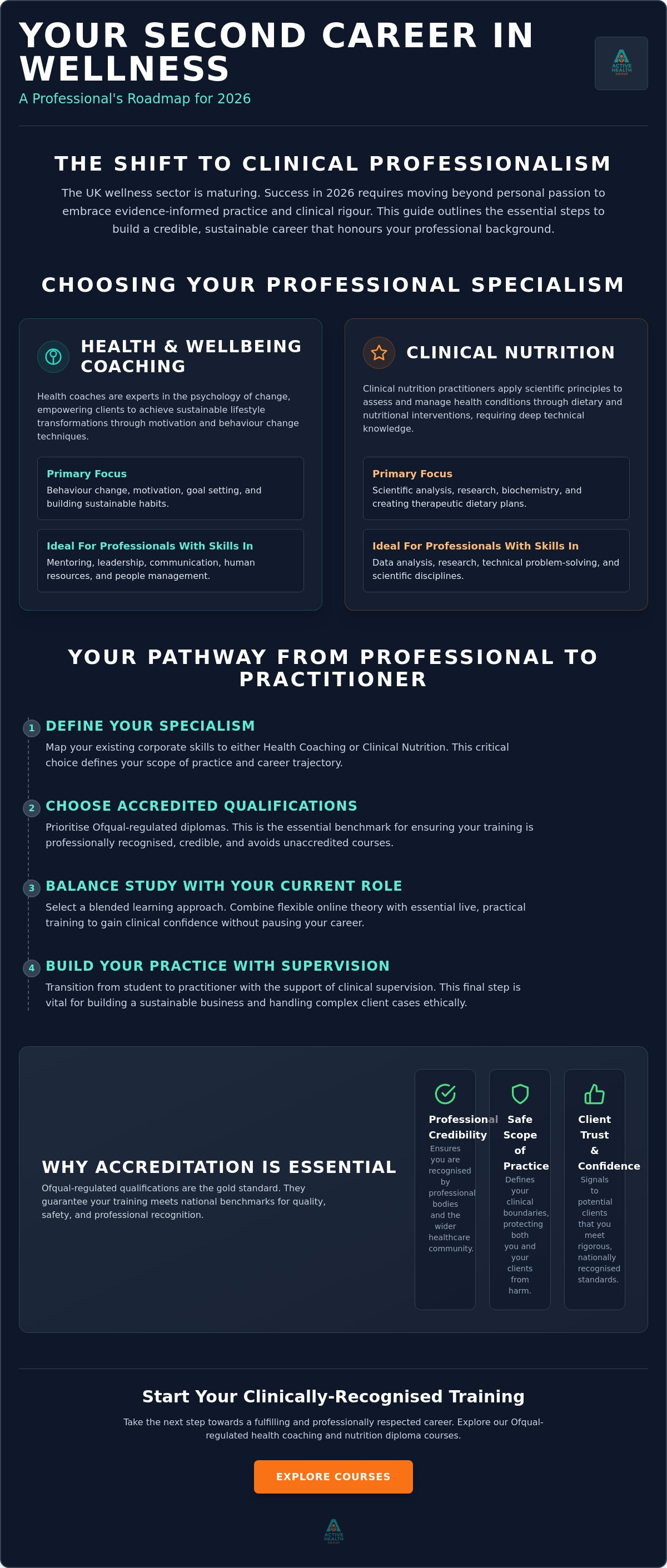
How to Organise Your Retraining Without Leaving Your Current Role
Transitioning to a second career in wellness UK does not require a reckless leap into the unknown. For most professionals, a managed, phased approach is the most sustainable way to protect financial stability whilst building a new professional identity. By viewing your tuition as a strategic investment in a future business, you can justify the time and capital required. A realistic timeline from enrolment to your first paying client typically spans 12 to 18 months, depending on the level of clinical depth you choose to pursue. This period allows you to integrate new knowledge without the immediate pressure of replacing your full-time salary.
Your previous corporate experience is a significant asset in this transition. Skills in project management, client communication, and digital marketing are directly applicable to running a private practice. You aren't starting from zero; you're layering clinical expertise onto an existing professional foundation. This perspective reduces the anxiety of "starting over" and helps you position yourself as a mature, experienced practitioner from day one. It's about moving from one professional sphere to another with your credibility intact.
The Phased Transition Strategy
A structured approach prevents burnout and ensures high standards of learning. We recommend a three-step progression:
Step 1: Begin with a Level 3 Health Coaching foundation. This provides a low-risk environment to test your aptitude for the role and understand the basics of behaviour change.
Step 2: Progress to Level 5 or Level 6 diplomas whilst still in your current role. This stage is where you build the clinical rigour and evidence-informed practice that will define your reputation.
Step 3: Begin a part-time practice. Managing a small number of clients allows you to build a portfolio and refine your clinical scope of practice before making the final transition to self-employment.
Maximising Blended and Online Learning
Blended learning is the most effective model for working professionals. It combines the convenience of online theory with the essential practical application found in live training centres. To succeed, you must integrate study into your existing schedule with discipline. This might mean dedicated deep-work blocks on Saturday mornings or utilising commute time for lectures. Live tutor support is non-negotiable; it provides the ethical oversight and clinical feedback that automated courses lack. Creating a dedicated professional study space at home further reinforces your commitment to this new career path.
If you're ready to begin your professional transition, our Health Coach Access Course is designed specifically to help you bridge the gap between your current role and your new career in wellness.
Establishing Your Practice: From Student to Professional Practitioner
The final stage of your transition into a second career in wellness UK involves moving from the safety of a learning environment into the complexities of professional practice. This is where your theoretical knowledge meets the reality of client care. Success as a practitioner isn't just about what you know; it's about how you apply that knowledge within a sustainable business model. Establishing a practice requires a clear identity, a defined clinical scope, and a commitment to maintaining the highest professional standards. You've spent months or years retraining, and now it's time to translate that effort into a service that delivers genuine value.
Positioning yourself effectively in the UK wellness market means moving away from being a generalist. When you try to speak to everyone, you often end up reaching no one. By identifying a specific niche, you can tailor your evidence-informed protocols to meet the unique needs of a particular group. This approach doesn't just make your marketing more efficient; it allows you to develop a deeper level of expertise that drives better client outcomes and more consistent referrals.
Specialising for Success
General "wellness" is often too broad to attract a loyal client base in a competitive market. Specialising in a specific area makes your clinical work more focused and your brand more memorable. For example, focusing on Men’s Health Coaching allows you to apply specialist knowledge to the physiological and psychological challenges unique to that demographic. This integrative approach, which combines targeted coaching techniques with specialist nutrition knowledge, sets your practice apart from those offering generic advice. When you deliver measurable, evidence-based results, your reputation as a specialist will grow naturally.
The Active Health Group Professional Pathway
Active Health Group has spent 25 years training practitioners who are ready for the demands of the UK health sector. We focus on the practical skills that allow you to work with clients immediately upon graduation, ensuring you feel confident in your clinical scope of practice. However, the conclusion of your formal training is really just the beginning of your professional development. We place a strong emphasis on clinical supervision, which is a vital tool for ethical practice. It provides a structured space to reflect on your cases, ensure client safety, and continue learning from experienced mentors.
Lifelong learning is a recurring thread amongst our global alumni network. As the wellness sector evolves, staying current with the latest health sciences is essential for any professional. Our graduates benefit from a community of peers who share insights and support each other's career growth. If you're looking for further guidance on starting your practice, our Resources page offers a wealth of information for aspiring health professionals. Your transition to a second career in wellness UK is a significant professional undertaking, and we're here to support you at every stage. You can request a prospectus to see our full range of Ofqual-regulated qualifications or speak directly with a tutor to discuss which pathway best aligns with your goals.
Step Into Your Professional Future in Wellness
Transitioning to a second career in wellness UK is a significant professional evolution that requires more than passion; it demands a commitment to clinical excellence and ethical practice. By prioritising Ofqual-regulated qualifications and a clear specialism, you move from being a general enthusiast to a respected practitioner with a defined scope of practice. This roadmap has illustrated that a phased transition, supported by blended learning and clinical supervision, is the most sustainable path to long-term success in the health sector.
Active Health Group brings 25 years of practitioner-led training experience to your professional development. As a not-for-profit organisation dedicated to maintaining the highest industry standards, we provide accredited pathways from Level 3 foundations through to advanced Level 6 clinical diplomas. You don't have to navigate this transition alone. Explore our Level 6 Health Coach and Clinical Nutrition pathway today to begin your development as a credible health professional. We look forward to supporting your transition into a rewarding and impactful new vocation.
Frequently Asked Questions
Can I start a second career in wellness without a prior science degree?
You don't need a prior science degree to start a second career in wellness UK. Most Ofqual-regulated diplomas are designed to build your knowledge from the ground up, providing the necessary foundations in anatomy, physiology, and nutrition science. This structure allows professionals from corporate or creative backgrounds to transition safely and effectively into clinical practice without returning to university for three years.
How long does it typically take to qualify as a health coach in the UK?
It typically takes between 6 and 18 months to qualify as a health coach, depending on the depth of the qualification you choose. A Level 3 foundation can be completed in a few months, whilst a comprehensive Level 5 or Level 6 diploma requires a more significant time investment. This duration ensures you have sufficient time to master both clinical knowledge and behaviour change psychology.
Is health coaching a regulated profession in the United Kingdom?
Health coaching is not currently a statutorily regulated profession in the UK, but it is governed by strong voluntary standards. Organisations like the UK & International Health Coaching Association (UKIHCA) set the benchmark for professional conduct and training. For those seeking roles within the NHS, accreditation from the Personalised Care Institute (PCI) is a mandatory requirement for coaches to ensure clinical safety.
What is the difference between a Level 5 and a Level 6 wellness qualification?
A Level 5 qualification is the industry standard for professional practitioner status, whereas Level 6 is equivalent to the final year of an undergraduate degree. Level 6 diplomas provide significantly greater depth in clinical nutrition and complex physiological support. This allows for a more advanced scope of practice compared to the foundational coaching and lifestyle skills taught at Level 5.
Can I work for the NHS with a private health coaching diploma?
Yes, you can work for the NHS with a private diploma, provided the course is accredited by the Personalised Care Institute (PCI). The NHS frequently employs health and wellbeing coaches at Band 5 salary levels, which range from £32,073 to £38,308 for the 2026/27 period. Ensuring your training provider meets these specific standards is essential for any public sector career path.
How much can I expect to earn in a second career in wellness?
You can expect to earn an average salary of approximately £28,345 per year in a second career in wellness UK as of June 2026. In private practice, many coaches charge between £60 and £150 per hour for one-on-one sessions. Self-employed nutritionists typically charge between £45 and £75 for an initial consultation, with follow-up fees ranging from £30 to £50 depending on their specialism.
What insurance do I need to practice as a wellness professional in the UK?
You must hold professional indemnity and public liability insurance to practice safely as a wellness professional in the UK. Most reputable insurers will only grant cover if you hold a qualification that is regulated by a recognised awarding body like Ofqual. This insurance protects both you and your clients whilst confirming that you are working within your professional scope of practice.
Do I need to attend in-person classes to qualify?
You don't necessarily need to attend in-person classes every week, but practical training is highly recommended for clinical readiness. Many high-quality programmes use a blended learning model. This allows you to complete theoretical science and coaching psychology online whilst attending intensive live sessions. These sessions are vital for refining your practical skills and receiving direct feedback from experienced tutors.


https://www.999eejl.com/ makes account access an important part of my overall website assessment, especially before exploring online slots or any other listed gaming category. I would first look for registration and login options, then review what information is requested and whether the available terms explain account requirements. If a visitor can move between slots, sports-related pages, or other game sections, the interface should make the account journey and relevant restrictions understandable. Automated analysis has detected registration-form functionality, but the exact registration steps, identity checks, recovery process, and age-verification requirements have not been established by the available source. I would not assume these details without confirmation. Before submitting personal information, I would also look for privacy terms and clear operator details. In my…
Nohu90 khiến mình chú ý đến cách những cơ chế nhỏ có thể trở thành mốc để mình tìm đúng nhóm Nổ hũ đang quan tâm. Có lúc mình bắt đầu từ Wild và Scatter, lần khác lại tìm các trò có hệ số nhân hoặc Free Spin trước. Mình không cần mở từng lựa chọn để xác định kiểu chơi mà có thể thu hẹp phạm vi từ đặc điểm đang muốn xem. Sau đó, nếu chuyển sang Casino, mình quay về phần danh mục rồi mới tìm Baccarat hoặc Roulette. Cách đi từ cơ chế đến trò cụ thể giúp khu Nổ hũ dễ quan sát hơn, trong khi các sảnh khác vẫn giữ được hướng tìm riêng trên…
https://hi88.report/ khiến tôi quan tâm đến cách phần khuyến mãi được đặt bên cạnh những hướng dẫn sử dụng cơ bản. Thay vì chỉ nhìn vào mức thưởng được nhắc lại từ nguồn bên ngoài, tôi ưu tiên kiểm tra điều kiện hiện hành và thời điểm áp dụng trước khi đánh giá chương trình. Trong lúc khám phá, thể thao, casino trực tuyến, slot, bắn cá và xổ số giúp tôi nhận biết phạm vi nội dung mà các nguồn liên quan mô tả về Hi88. Cách tách ưu đãi thành một khu riêng giúp thông tin dễ theo dõi hơn và tránh lẫn với phần sản phẩm. Vì chương trình có thể thay đổi, tôi cho rằng dữ liệu…
qq88 làm mình chú ý đến cách các nhóm khác nhau vẫn giữ được nhận diện riêng khi cùng xuất hiện trong một hệ sinh thái. Mình thường nhìn tổng thể giao diện trước để xác định hướng, sau đó mới đi sâu vào khu đang quan tâm. Với Game bài, eSports và Casino, việc bố trí theo từng phần giúp mình chuyển nội dung mà không bị mất dấu khu vừa rời. Khi quay lại sau một khoảng thời gian, cấu trúc quen thuộc cũng giúp mình nhận ra các vị trí nhanh hơn. Mình thấy cách tổ chức này phù hợp với thói quen thay đổi nội dung khá thường xuyên trong một phiên. Tổng thể vẫn giữ được…
https://qq887p.com/ cho mình một hướng quan sát liên quan đến sự phong phú của nội dung. Casino, thể thao, xổ số, đá gà, nổ hũ, bắn cá và game bài tạo thành những nhóm có hành vi sử dụng khá khác nhau. Mình không cố xem hết tất cả, mà chọn từng nhóm đại diện rồi so sánh mục đích tiếp cận của chúng. Một người tìm tỷ lệ thể thao sẽ có cách sử dụng khác người đang khám phá một trò giải trí. Việc đặt các nhóm cạnh nhau giúp mình nhận ra hệ thống đang phục vụ nhiều nhu cầu song song như thế nào. Đây là cách nhìn vào độ rộng của hệ sinh thái mà không…