.png)


Tips for Active Health Group Success: A Practitioner’s Guide for 2026

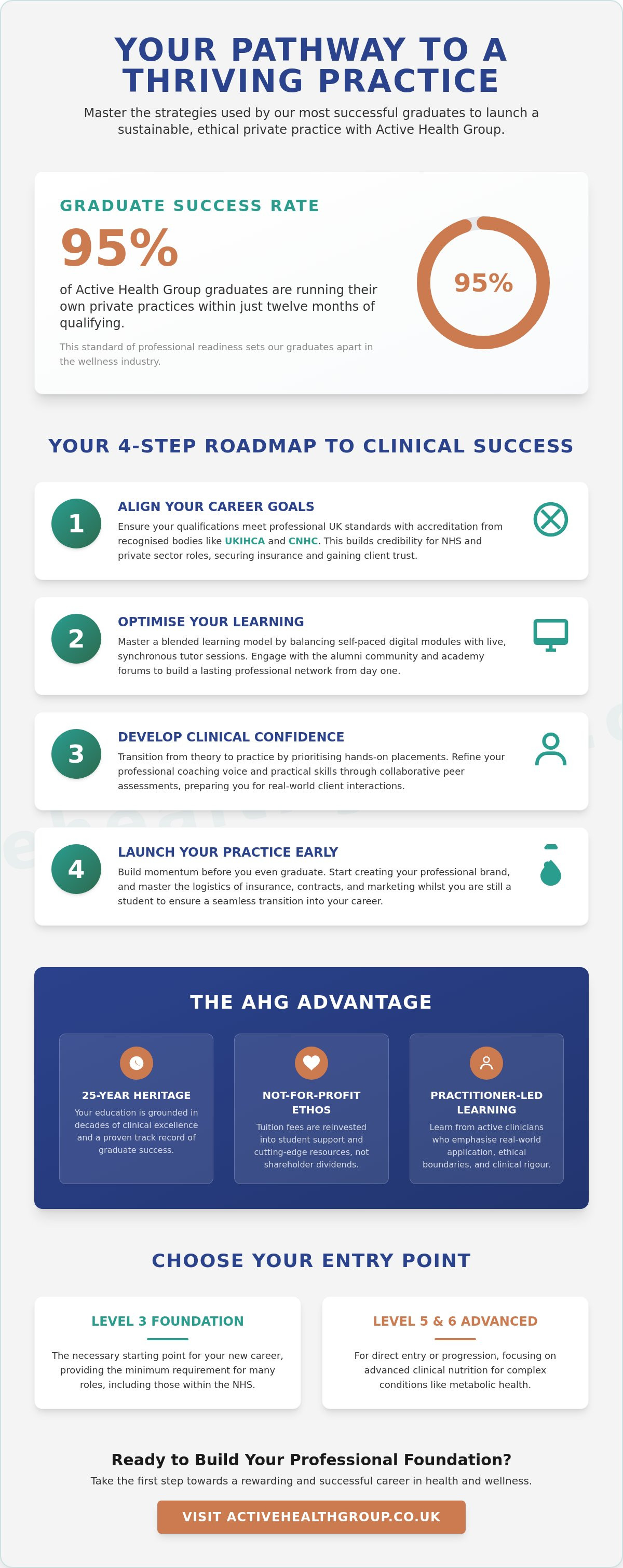
Did you know that 95% of Active Health Group graduates are running their own private practices within just twelve months of qualifying? While many wellness courses leave students with a certificate but no clear path forward, this 2025 data highlights a different standard of professional readiness. You likely recognise the weight of this responsibility, yet you might feel a flicker of anxiety about balancing Level 5 or 6 studies with your current professional commitments.
Perhaps you've been searching through active health group reviews to see how others navigated the complexities of UKIHCA accreditation whilst building the confidence to see their first clinical clients.
It's natural to feel some trepidation when moving from academic study to real-world practice, especially when meeting rigorous UK standards. This guide will show you how to master the strategies used by our most successful graduates to launch a sustainable, ethical private practice. We'll explore how to integrate clinical ethics into your learning, simplify the UKIHCA registration process, and build a professional foundation that lasts well beyond your final assessment.
Key Takeaways
Align your career objectives with UKIHCA, and FNTP standards to ensure your practice meets the professional credibility required for NHS and private sector roles.
Optimise your learning schedule by balancing self-paced digital modules with live tutor sessions and using active health group reviews to inform your networking within the alumni community.
Develop clinical confidence by prioritising hands-on placements and refining your professional coaching voice through collaborative peer assessments.
Create early momentum for your private practice by building your professional brand and mastering the logistics of insurance and contracts whilst still a student.
Leverage the AHG Advantage of a 25-year heritage and not-for-profit structure to ensure your education is grounded in clinical excellence and ethical practitioner standards.
Table of Contents
Mastering the AHG Roadmap: Aligning Your Goals with Accredited Standards
Success in the wellness industry requires more than passion; it demands a clear professional trajectory. Before you enrol, define your career endgame. Whether you aim for NHS primary care integration, corporate wellness consultancy, or a bespoke private practice, your choice of pathway dictates your future scope of practice. Many prospective students look through active health group reviews to see how others have transitioned from unrelated sectors into clinical roles, often noting that the clarity of the AHG roadmap was a deciding factor in their professional journey.
Professional credibility in the UK relies heavily on alignment with recognised bodies. For health coaches and nutritional therapists, this means understanding the roles of the UK Health Coaches Association (UKIHCA), and the Federation of Nutritional Therapy Practitioners (FNTP). As these roles become more prominent amongst the allied health professions, holding an accredited qualification ensures you can secure insurance and gain the trust of both clients and medical colleagues. Because AHG is a not-for-profit organisation, tuition fees are reinvested directly into learning resources and student support, ensuring that the curriculum reflects the most current clinical evidence rather than shareholder interests.
Choosing Your Entry Point: Foundation vs. Advanced
Selecting the right level is vital to avoid redundant learning. You should evaluate if the Level 3 Health Coaching Foundation is your necessary starting point or if your prior experience allows for direct entry into Level 5 or Level 6 programmes. Level 3 provides the minimum requirement for NHS roles, whilst Level 6 focuses on advanced clinical nutrition for metabolic health. Mapping your existing skills against the AHG pathway ensures you build on your strengths without unnecessary delay, a point frequently praised in various active health group reviews from successful alumni.
The AHG Philosophy: Practitioner-Led Learning
The AHG approach prioritises real-world readiness. You aren't just learning theory; you're engaging with a practitioner-led model that emphasises practical application and ethical boundaries. From day one, you're expected to uphold high professional standards, balancing coaching psychology with clinical rigor. This grounded methodology prepares you for the weight of professional responsibility, moving you from a student mindset to that of a confident, ethical practitioner capable of making a meaningful impact.
Maximising Success in the AHG Online Academy
The transition into the AHG Online Academy marks the shift from prospective student to active practitioner-in-training. This digital environment is not merely a repository for documents; it's a dynamic hub designed for a blended learning model. To succeed, you must organise your week to accommodate both self-paced digital modules and live, synchronous tutor sessions. Prospective students often scan active health group reviews to understand the digital learning experience, and they frequently find that the most successful graduates are those who treated the academy as a virtual clinic from day one.
Modern practice requires a robust framework for educating health professionals that addresses complex health determinants. The AHG curriculum reflects this by providing specialised resources in metabolic health and burnout. Engaging with these materials early allows you to deepen your clinical niche before you even reach your final assessments. Don't overlook the academy forums; connecting with your global alumni network early provides a support system that extends far beyond the duration of your course.
Digital Study Strategies for Busy Professionals
Consistency is more effective than occasional intensity. We recommend setting a "Clinical Hour" each day to focus on evidence-based research within the academy. This habit mirrors the administrative time required in a private practice. You can download specific resources for offline review to maintain momentum whilst commuting. Tracking your progress through the milestones of the Level 6 Diploma in Clinical Nutrition or your chosen pathway ensures you remain focused on the professional standards required for accreditation.
Engaging with Tutor Support and Mentorship
The tutor support system is a cornerstone of the AHG experience, yet it's often underutilised. Rather than waiting for assessment deadlines, you should be proactive. Prepare specific, clinical questions for your tutors to maximise the value of your time with them. Seeking feedback on your coaching behaviour early in the course allows you to refine your professional voice in a safe environment.
View your tutors as mentors who have already navigated the challenges of the UK health landscape. Their insights into client contracts and professional boundaries are as valuable as the scientific theory they teach. If you're ready to begin this journey, you can explore our practitioner resources to see the depth of support available.
Mastering Clinical Competence and Practical Assessments
Transitioning from theoretical study to clinical application is often the most daunting phase of professional development. Whilst the Online Academy provides the scientific foundation, your clinical competence is forged through hands-on experience with diverse client cases. Many active health group reviews from our alumni emphasise that the shift from observer to practitioner was the moment their professional identity truly solidified. To succeed, you must prioritise your clinical placements early, ensuring you have ample opportunity to apply coaching psychology in real-world scenarios before your final evaluations.
High standards of practice aren't just about what you know; they're about how you deliver care. This commitment to quality mirrors the rigour found in NCQA Accredited Programmes, where systematic evaluation ensures the highest level of service delivery. Within the AHG framework, you must document your clinical hours meticulously. This isn't merely a box-ticking exercise; it's a requirement for CNHC registration and a vital part of building an ethical, transparent practice. Focusing on the Scope of Practice modules ensures you advise clients safely, legally, and within the boundaries of your professional insurance.
Preparing for Your Practical Clinical Assessments
Anxiety over clinical assessments is common, but preparation is the most effective antidote. We recommend reviewing the assessment criteria for the Level 6 Clinical Nutrition diploma at least three months in advance. One of the most effective strategies is recording your practice sessions with fellow students. By reviewing these recordings, you can identify subtle patterns in your non-verbal communication and refine your coaching scripts. This process helps you move away from a "checklist" mindset and towards genuine, person-centred care, which is the benchmark of a successful AHG practitioner.
Specialising for Success: Gut Health and Men’s Health
In a competitive wellness market, specialisation is a powerful tool for differentiation. Integrating specialist knowledge into your case studies demonstrates advanced clinical reasoning and allows you to narrow your market focus early. For instance, a Level 5 Certificate in Gut Microbiome and Nutrition provides a specific clinical lens that is highly valued in private practice. Similarly, applying your training to niches like Men’s Health Coaching allows you to speak directly to the needs of a specific demographic. By mastering these specialised areas, you don't just gain a certificate; you build a unique professional voice that resonates with your ideal clients.
Transitioning from Student to Professional Practitioner
The leap from student to professional practitioner is often where many wellness professionals falter. However, data from 2025 shows that 95% of graduates from these programmes launch their own private practices within a year of qualifying. This success isn't accidental; it's the result of early integration. You shouldn't wait until you receive your diploma to think about your business. Starting to build your professional brand whilst you're still studying creates vital early momentum.
Prospective clients value the journey of a practitioner who is deeply immersed in current health sciences. When researching active health group reviews, you'll find that graduates who utilised the business modules during their final months were the ones who transitioned most seamlessly into clinical practice.
Professional body memberships should be your first priority upon receiving your diploma. Applying for registration with the UKIHCA or FNTP immediately provides the professional recognition required to work alongside other healthcare providers. This step isn't just about a badge on your website; it's about joining a community of practitioners committed to high ethical standards and evidence-based care. If you're ready to move from theory to clinical practice, explore our practitioner resources to download your business launch templates.
The Business Readiness Checklist
Success in private practice requires a foundation of professional integrity. You must establish your legal structure, whether as a sole trader or a limited company, before seeing your first private client. Professional indemnity insurance is non-negotiable for UK practitioners. It protects both you and your clients. You should also develop a clear Scope of Practice statement. This document defines your professional boundaries and helps you communicate your value to prospective clients and healthcare partners. Linking your clinical training to a specific service offering, such as a targeted metabolic health or burnout recovery programme, makes your expertise tangible and accessible to those who need it most.
Leveraging the AHG Alumni Network
The AHG community is a significant asset for any new practitioner. Networking within this group isn't just about socialising; it's about finding referral partners and collaborators. Attending AHG events allows you to stay updated on the latest clinical research and industry trends whilst maintaining connections with your peers. Collaboration often leads to better client outcomes, as you can offer integrative health solutions by working with practitioners from different disciplines. Seek out peer supervision groups within the alumni community early. These groups provide a safe space to discuss complex cases and ensure you maintain the highest ethical standards as you grow your practice. Many active health group reviews highlight that this ongoing support is what prevents the isolation often felt by new private practitioners.
The AHG Advantage: Why This Path Leads to Long-Term Success
Active Health Group has spent over 25 years refining the pathway from student to expert practitioner. Since our inception in 2000, we've trained over 10,000 students, creating a legacy of clinical excellence that few institutions can match. This stability matters in a rapidly evolving wellness sector. When you read active health group reviews, the recurring theme isn't just the quality of the content, but the stability of the institution itself. Choosing a provider with a quarter-century of heritage ensures your credentials carry weight with insurers, professional bodies, and medical colleagues alike.
Our not-for-profit status is a fundamental pillar of this success. Unlike commercial providers driven by shareholder returns, every pound of your tuition is reinvested into course development, tutor support, and the Online Academy infrastructure. This ensures that the focus remains entirely on your professional outcomes rather than profit margins. It's this commitment to quality over volume that allows us to maintain a 95% course completion rate and see our graduates thrive in the private sector. By removing the pressure of shareholder profit, we can prioritise the clinical rigor required for Level 6 excellence.
Integrity and Ethics in a Non-Regulated Industry
The UK health coaching market remains largely unregulated, which makes the choice of training provider a significant ethical decision. AHG standards act as a proxy for regulation, ensuring that every graduate operates within clear professional boundaries and clinical rigor. Our practitioner-first mentality means we prioritise the integrity of the profession over the mere acquisition of credentials. We are committed to fostering a generation of health professionals who value evidence, ethics, and person-centred care above all else. This grounded approach ensures you enter the field as a professional, not just a certificate holder.
Your Future as an AHG Graduate
Visualise your practice twelve months from today. You aren't just seeing clients; you're operating a sustainable, ethical business supported by the evidence-based training you receive now. Long-term success requires a commitment to lifelong learning, moving from foundational Level 3 certificates to advanced Level 6 clinical excellence. You should plan your continuing professional development (CPD) through AHG’s advanced clinical modules to stay at the forefront of metabolic health and nutrition science. By joining this community of purpose, you're ensuring that your career is built on a foundation of reliability and depth, a fact often reflected in the most positive active health group reviews from our long-term alumni.
Ready to start? Explore our professional training pathways today.
Building Your Future in Professional Wellness
Transitioning from a student mindset to that of a professional practitioner is a structured journey that requires both clinical rigor and a commitment to ethical standards. By aligning your career goals with UKIHCA and FNTP accreditation pathways, you ensure your practice holds the credibility necessary for success in the UK health landscape. Many individuals researching active health group reviews discover that our not-for-profit model is a significant differentiator; it ensures your tuition is reinvested directly into the quality of your learning resources and tutor support.
This dedication to practitioner-led education is why 95% of our graduates are running their own private practices within twelve months of qualifying. It's a success rate built on the foundation of clinical rigor and practical readiness. You now have the roadmap to navigate the Online Academy, master your clinical assessments, and build a sustainable brand whilst you study. Your future as a confident, accredited health professional starts with choosing a pathway that values your long-term success as much as you do. Take the next step in your professional development today.
View our Accredited Health and Nutrition Courses and join a community dedicated to clinical excellence. We look forward to supporting your journey into professional practice.
Frequently Asked Questions
Is Active Health Group accredited by the UKIHCA?
The UKIHCA approve our Level 5 Advanced Diploma in Integrative Health and Nutrition Coaching course. This leads to full membership. Active Health Group courses are fully aligned with the UK Health Coaches Association (UKIHCA) standards. Our Level 5 professional pathways include the required 120 hours of live, synchronous training necessary for full approval. This ensures that you meet the rigorous professional criteria required to obtain insurance and practice safely within the UK wellness sector.
Can I work in the NHS with an AHG Level 6 Diploma?
You can certainly work within the NHS with an AHG Level 6 Diploma, as our training aligns with the Personalised Care Institute (PCI) competencies. Whilst a Level 3 Certificate is the minimum requirement for health coaching roles in primary care, a Level 6 qualification provides the advanced clinical reasoning necessary for complex metabolic cases. This higher-level training prepares you for integrated roles within primary care networks.
How much time per week do I need to study for the Level 5 Health Coaching course?
Most students find that dedicating approximately eight to ten hours per week allows them to progress through the Level 5 Certificate in Coaching for Health and Wellbeing effectively. This time is split between self-paced digital modules in the Online Academy and live tutor-led sessions. Because our model is designed for busy professionals, you can organise your study schedule to fit around existing commitments.
What happens if I fail a practical clinical assessment?
If you don't pass a practical clinical assessment on your first attempt, we provide comprehensive feedback and a clear pathway for a retake. Our practitioner-led mentors can work with you 1-to-1 to identify specific areas for improvement, whether in clinical reasoning or coaching behaviour. We view assessments as learning milestones, ensuring you have the confidence and competence to succeed in real-world practice.
Do I need a degree to succeed with Active Health Group?
You don't need a university degree to succeed with Active Health Group, as we offer a clear progression pathway from foundational to advanced practice. Many of our most successful students enter at Level 3 and build their expertise incrementally. Our "Access to Health Coaching" courses are specifically designed to bridge the gap for those returning to education or transitioning from unrelated professional backgrounds.
How does the not-for-profit model benefit me as a student?
Our not-for-profit status means that every pound of your tuition is reinvested back into your education rather than being distributed as shareholder profit. This allows us to maintain a high tutor-to-student ratio and provide extensive clinical resources that commercial providers often lack. When reading active health group reviews, students frequently note the depth of support as a direct benefit of this mission-driven educational model.
Can I specialise in gut health whilst completing my clinical nutrition diploma?
You can integrate specialised training, such as the Level 5 Certificate in Gut Microbiome and Nutrition, whilst completing your Level 6 Diploma in Clinical Nutrition. This dual-focus approach allows you to build a specific clinical niche before you qualify. Specialising early is a strategy used by many of our graduates to differentiate their private practice and demonstrate advanced reasoning in complex client cases.
What support is available if I struggle with the online learning platform?
We provide dedicated technical and academic support for all students using the AHG Online Academy. If you struggle with the digital platform, our team are available to guide you through the process. Our active health group reviews often highlight the accessibility of our staff, ensuring that technical hurdles don't impede your progress towards professional accreditation and clinical practice.


Has anyone else used a name generator for character names? I tried it while working on a fantasy character and found several combinations that fit the theme nicely.
Traditional karyotyping uses dye to stain the chromosomes of a metaphase cell in distinct banding patterns. The most common method is Giemsa staining, also known as G-band karyotyping or G-banding, other methods.