.png)


Trauma Informed vs Trauma Responsive Coaching: Professional Standards for UK Practitioners

What if your commitment to "do no harm" is actually preventing you from providing the support your clients truly need? Many UK practitioners feel a deep responsibility towards clients with complex emotional histories, yet remain hesitant for fear of crossing the line into clinical therapy. Understanding the distinction between trauma informed vs trauma responsive coaching is essential for professionals who want to offer safe, evidence-informed support without overstepping their scope of practice.
You likely recognise that standard behaviour change often fails when a client's nervous system is stuck in a state of reactivity. This article provides the clarity you need to move from basic awareness to active, ethical responsiveness. Drawing on Active Health Group’s 25-year heritage in practitioner training, we will define these professional standards and outline a framework for maintaining client safety, whilst exploring how advanced qualifications help you integrate these skills with confidence.
Table of Contents
Trauma Informed vs Trauma Responsive: Defining the Professional Boundary
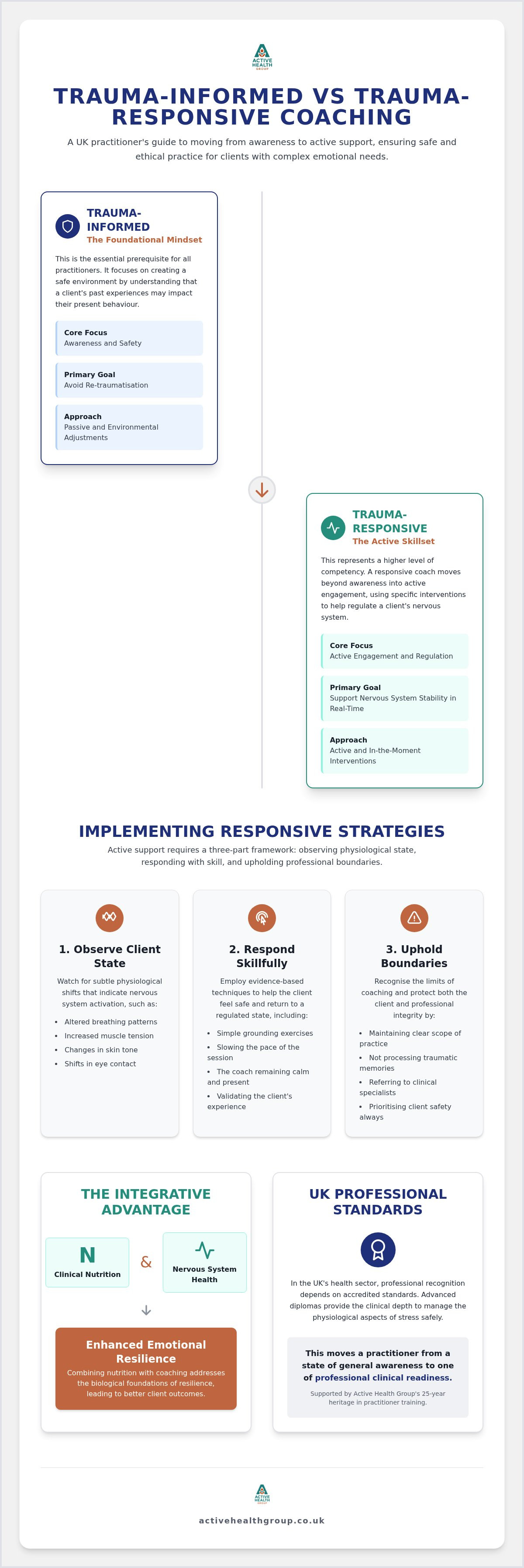
Professionalism in the UK health sector requires a clear understanding of the distinct levels of care available to clients. At its core, trauma-informed practice focuses on awareness and the avoidance of re-traumatisation. It's about recognising that a client's history may impact their progress and adjusting the environment accordingly. However, the conversation around trauma informed vs trauma responsive coaching highlights a significant shift in practitioner competency and ethical responsibility.
Being trauma-informed is the essential prerequisite for becoming responsive. A trauma-responsive coach moves beyond awareness into active engagement, employing specific interventions to support nervous system regulation when a client becomes overwhelmed. This transition from awareness to action ensures practitioners can:
Identify physiological signs of emotional reactivity in real-time.
Utilise grounding techniques to maintain client stability.
This defines the clinical depth required in advanced Level 5 health coaching. It ensures practitioners possess the skills to manage physiological responses safely and ethically.
Core Principles of Trauma-Informed Practice
Establishing physical and emotional safety is the primary objective of an informed approach. Practitioners build trust through transparency and clear professional boundaries to ensure client stability. This involves collaborative goal setting that respects the autonomy of the individual whilst maintaining a supportive environment. These elements are explored in depth when studying What is Trauma-Informed Care? to ensure practitioners meet modern health standards. Trauma-informed coaching is a foundational mindset of safety and awareness.
Active Support: Implementing Trauma-Responsive Strategies
Effective trauma-responsive coaching prioritises the client's present-moment physiological state. Whilst being informed establishes a baseline of safety, the distinction in trauma informed vs trauma responsive coaching lies in active regulation. This involves using specific techniques to help clients move out of survival modes and return to a state of curiosity and choice. A practitioner’s ability to stay grounded during these moments is vital for maintaining a secure professional container.
A unique aspect of this work involves integrating nutrition knowledge to support emotional resilience. Research suggests that physiological health directly impacts a client's capacity to manage stress. By understanding the link between gut health and nervous system function, coaches can offer a more comprehensive form of support. This integrative approach is a core component of the Level 6 Health Coach and Clinical Nutrition Diploma, which provides the evidence-based tools needed for this level of practice.
Recognising Activation and Threat Responses
Practitioners must observe subtle physiological shifts like altered breath patterns or increased muscle tension. These markers provide immediate data. Holding space for strong emotions requires the coach to remain regulated, preventing their own nervous system from mirroring the client's distress. Evidence-based interventions focus on calming the nervous system to allow for cognitive processing. Following SAMHSA's Trauma-Informed Approach ensures that interventions remain ethical and safe. If a client’s needs exceed the coaching scope, practitioners have a duty to refer them to clinical specialists. Maintaining these boundaries protects both the client and the professional integrity of the relationship. For those looking to deepen their expertise, exploring our practitioner resources can provide further clinical insights.
Ethical Practice and Career Progression in the UK
Establishing a career in the UK health coaching sector requires a commitment to rigorous educational pathways. Whilst the private industry remains largely unregulated, professional recognition depends on following accredited standards that distinguish between different levels of competency. The discussion of trauma informed vs trauma responsive coaching is central to this professionalisation. Ethical standards are not merely guidelines. They protect both the client and the practitioner during complex coaching scenarios where emotional reactivity might occur.
Active Health Group has a 25-year heritage in providing training that prioritises these professional boundaries. By choosing advanced diplomas, practitioners gain the clinical depth necessary to manage the physiological aspects of stress. Integrative health coaching, which combines behaviour change with nutritional science, leads to better outcomes as it addresses the biological foundations of resilience. This approach moves the practitioner from a state of general awareness to a state of professional clinical readiness.
Choosing the Right Qualification for Advanced Practice
Level 5 qualifications establish a solid foundation in professional coaching standards and ethics. The Level 5 Health Coaching course prepares students for real-world client challenges by providing a structured framework for safe, trauma-informed practice. For those seeking deeper clinical specialisation in areas like burnout or chronic fatigue, Level 6 diplomas offer a more comprehensive approach. Practitioners should consult the Active Health Group resources for guidance on UK regulation and professional body membership. These pathways ensure you operate within your scope of practice whilst delivering high-impact, evidence-informed care. Maintaining these standards is the hallmark of a serious professional in the wellness sector.
Establishing Professional Excellence in Health Coaching
Distinguishing between trauma informed vs trauma responsive coaching marks the transition from basic safety to clinical readiness. You now understand that whilst awareness prevents harm, active responsiveness provides the tools for nervous system regulation. Maintaining these rigorous standards ensures your practice remains ethical and effective within the UK health sector. It's about supporting clients through physiological reactivity whilst respecting professional boundaries.
Active Health Group supports your progression through our not-for-profit commitment to high ethical standards. With over 25 years of experience in practitioner education, our courses are accredited by leading UK professional bodies to ensure clinical depth. Explore our Level 5 and Level 6 Health Coaching Diplomas to build a practice rooted in integrity. We are here to support you as you establish yourself as a trusted professional.
Frequently Asked Questions
Is trauma-responsive coaching the same as therapy?
No, trauma-responsive coaching is distinct from clinical therapy. Whilst therapy involves diagnosing and processing past events, coaching focuses on present-moment regulation and future-focused behaviour change. A coach supports a client's physiological state to help them reach health goals, but they don't provide psychological treatment for clinical conditions. Maintaining this professional boundary is a core component of ethical practice.
Can a health coach work with clients who have experienced trauma in the UK?
Yes, practitioners in the UK can support clients with trauma histories provided they operate within their professional scope. The focus remains on creating a safe environment for health-related progress rather than treating the trauma itself. Understanding trauma informed vs trauma responsive coaching allows practitioners to recognise when a client's history impacts behaviour. This ensures they can adjust their approach for safety.
What are the signs that a client needs a referral to a therapist?
Practitioners must refer clients to a clinical professional if they observe signs of severe psychological distress. These include persistent flashbacks or suicidal ideation. If a client is unable to remain grounded in the present moment, they require specialist care. When a client needs to process past events, they should be referred to a registered counsellor or psychotherapist.
How does trauma-responsive coaching improve nutritional outcomes?
Trauma-responsive coaching improves nutritional outcomes by addressing the physiological barriers to change. When a client's nervous system is stuck in a threat response, their body prioritises survival over digestion and cognitive decision-making. Using regulation techniques to calm the nervous system helps clients return to a state of balance. This allows them to make conscious, health-promoting choices regarding their diet and gut health.
What level of qualification is required to be a trauma-informed coach?
Whilst the UK industry is currently unregulated, professional standards suggest a Level 5 qualification as the baseline for safe practice. Active Health Group’s Level 5 Advanced Diploma, backed by our 25-year heritage in practitioner training, provides the foundational ethics and awareness required. For those wishing to master trauma informed vs trauma responsive coaching, a Level 6 diploma offers the clinical depth needed.



Khi muốn kiểm tra thông tin mới nhất, mình thường chú ý đến ngày cập nhật trước tiên. Vì vậy, xổ số miền nam hôm nay sẽ hữu ích hơn nếu được đặt cùng thời gian và kết quả tương ứng, giúp người đọc biết chính xác mình đang xem dữ liệu của kỳ nào.
This piece provides a fresh and compelling take on the subject. I appreciate the depth of research and clarity in your writing. pokemon soulgold
I like the short challenge format of Drive Mad. It doesn't take long to understand the controls, while the obstacle layouts still keep things interesting.