


Mastering Myofascial Releases: Benefits for Practitioners

What if two practitioners both describe their work as myofascial release, yet use different methods? The term myofascial releases covers a range of hands-on techniques focused on fascia, the connective tissue surrounding and supporting muscles. Understanding those differences helps practitioners assess what a method involves and whether it fits their training and professional scope.
If you’re learning about these approaches, you need clear distinctions and a measured view of the evidence before applying them in practice. This article explains fascia in accessible terms, compares common features of different methods and considers what research can, and can’t, tell practitioners about their effects. It also sets out practical ways to develop your skills through structured training, evidence-informed judgement and reflection on professional boundaries.
Table of Contents
What are myofascial releases, and what does the evidence tell practitioners?
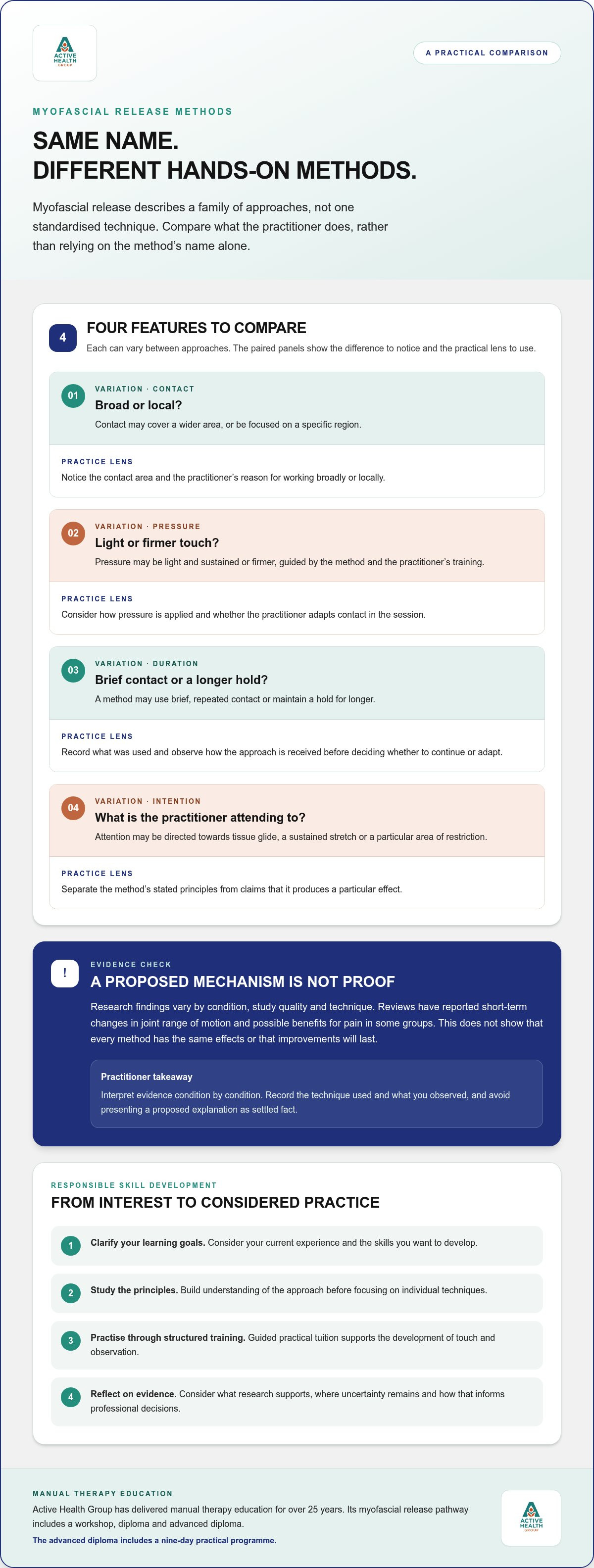
Myofascial releases are hands-on approaches that focus on fascia and its relationship with surrounding tissues. Practitioners may use sustained contact or stretching, but the methods differ in how they apply touch and how long they maintain it. The term describes a family of approaches, not one standardised technique. A general overview of Myofascial Release outlines its history and conceptual basis. Claims about effects should be considered in light of the available research.
How are fascia, trigger points and myofascial release related?
Fascia is connective tissue that surrounds, supports and links structures throughout the body, including muscles. It forms part of the wider tissue environment in which movement and touch are experienced. Some manual therapy approaches also refer to trigger points, usually described as sensitive areas within muscle or surrounding tissue. The term is used in different ways, and trigger points are not synonymous with fascia or myofascial release.
Myofascial release is a group of hands-on methods involving sustained contact or stretching directed at fascia and its relationship with surrounding tissues. This describes the approach, not a promised clinical result. Active Health Group’s myofascial release training offers practitioners a structured route to study these methods in greater depth.
Separate proposed explanations of how these techniques work from established anatomical descriptions. Research findings vary by condition, study quality and the specific technique used. Reviews have reported short-term changes in joint range of motion and possible benefits for pain in some groups. This does not establish that every method has the same effects or that improvements will last. For practitioners, the evidence calls for careful, condition-specific interpretation rather than broad promises. Record the technique used and what you observed, and avoid presenting a proposed mechanism as settled fact.
How do myofascial release techniques differ in practice?
Practitioners may use broad, sustained contact, a cross-hand stretch, skin rolling or a more localised hold. These approaches share a focus on engaging tissue through the hands, but differ in contact area, pressure, duration and practitioner intention. A method’s name alone doesn’t tell you exactly what happens during a session.
What should practitioners consider when comparing approaches?
Distinguish a technique’s stated principles from claims that it produces a particular effect. Consider what the practitioner does, what they observe and how they decide whether to continue or adapt their contact. Training helps develop touch awareness and a clear rationale for practice. Myofascial release methods are not one uniform protocol: contact, pressure, duration and guiding principles can all vary.
For example, one method may use broad, still contact held over an area, while another uses a smaller contact and gentle tissue movement. This describes a difference in application, not evidence that one approach is more effective. Technique choice should reflect professional assessment, the context of the session and the practitioner’s competence. Active Health Group’s myofascial release workshop gives practitioners a structured setting to examine these distinctions through guided practical learning.
How can practitioners develop myofascial release skills responsibly?
Developing skill means moving from interest in a technique to a clear, considered approach in practice. Before choosing further study, identify what you want to learn. You might want a stronger grounding in the principles, more confidence with hands-on methods or a longer-term route into specialist practice. Keep the evidence in view and don’t treat a technique’s rationale as proof of its effects.
Clarify your learning goals. Consider your current experience and the skills you want to develop.
Study the principles. Build a sound understanding of the approach before focusing on individual techniques.
Practise through structured training. Practical tuition gives you the chance to develop touch and observation with guidance.
Reflect on evidence. Review what research can support, where uncertainty remains and how that informs your professional decisions.
What can structured myofascial release training add?
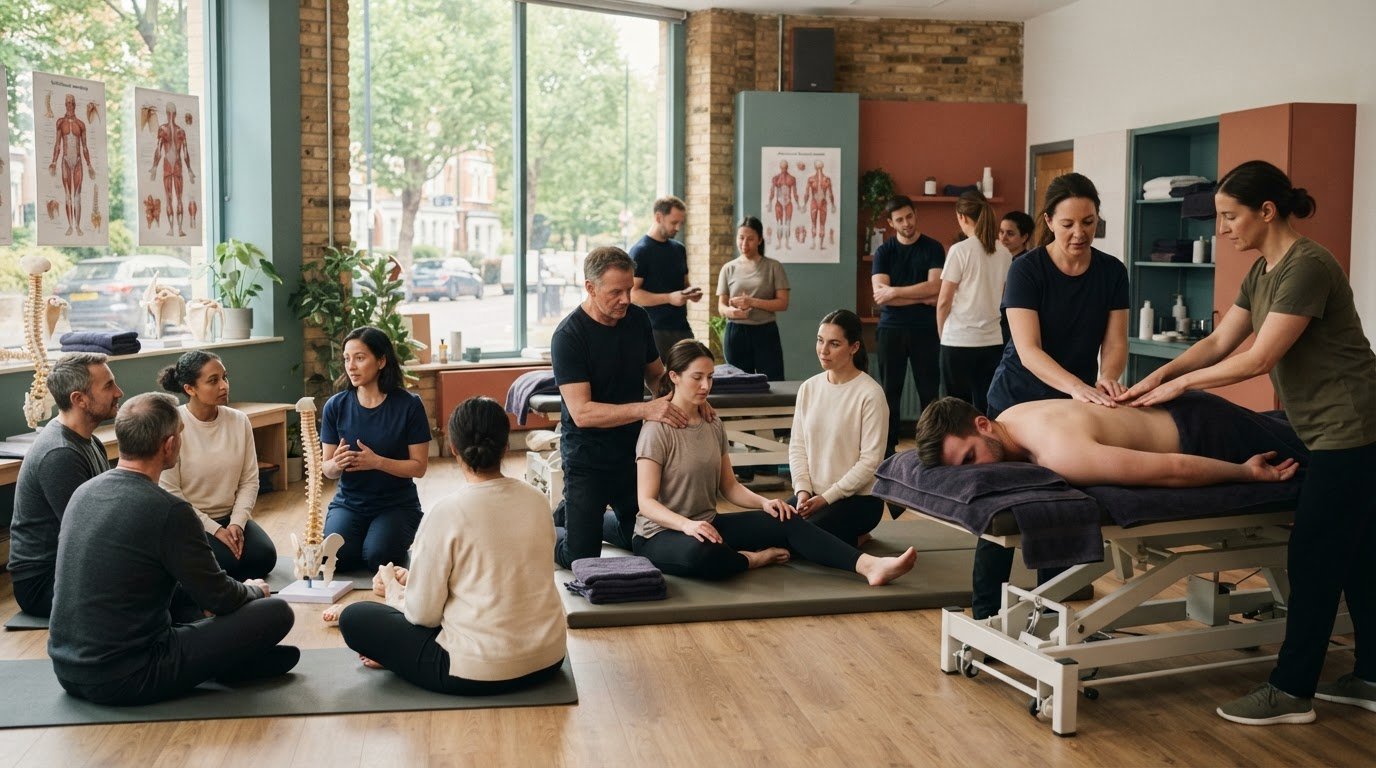
Hands-on skills develop through practice, feedback and opportunities to refine technique. In supervised learning, you can focus on contact and pressure, observe how your approach is received, and consider when to adapt. This connects practical choices with professional judgement, rather than relying on a memorised sequence alone.
Active Health Group has delivered manual therapy education for over 25 years and was among the first UK providers to offer a full myofascial release diploma, over twenty years ago. Its training pathway includes a workshop, diploma and advanced diploma. The advanced diploma includes a nine-day practical programme. To extend your learning, explore the Myofascial Release Advanced Diploma as one option for developing your knowledge and practical skills. Let your learning goals, training and ongoing reflection guide how you use myofascial releases in professional practice.
Turn your interest into a focused development plan
Start by identifying the practical skill you want to strengthen and deciding how you’ll build it. Set a clear learning goal, then plan how you’ll review new techniques, reflect on evidence and assess your development over time. This keeps professional growth grounded in thoughtful practice, rather than collecting methods without a clear purpose.
Myofascial releases can form part of a wider manual therapy skill set when studied carefully and within a clear understanding of your professional scope. If you’re ready to take your learning further, explore professional myofascial release training and choose the step that best fits your experience and aims. Active Health Group offers a workshop, diploma and advanced diploma to support your development in this area.
Frequently Asked Questions
Is myofascial release the same as trigger point therapy?
No. Trigger point therapy centres on specific sensitive points, while myofascial release can involve broader areas and different patterns of contact. The approaches can overlap in hands-on practice, but the names describe different focuses. For example, working around one focal tender area is not automatically the same method as applying a sustained stretch across a wider region.
Can you perform myofascial release on yourself?
Yes, self-myofascial techniques can be performed using tools such as a foam roller or massage ball. You control the contact and movement, applying pressure to an area yourself. This differs from practitioner-led work, where another person can vary hand contact and respond to what they observe. Self-directed methods are a distinct way to explore the approach, rather than a direct substitute for hands-on practitioner techniques.
Does myofascial release work for back pain?
Research suggests myofascial release may reduce pain for some people with low back pain, but it does not establish a guaranteed or lasting effect for everyone. Studies vary in their methods and quality, so findings should be interpreted cautiously. Practitioners should describe the evidence accurately and avoid promising that a particular approach will resolve a person’s back pain.
How does myofascial release differ from foam rolling?
Foam rolling is a self-applied technique: a person uses their body weight and movement to roll over a roller. Myofascial release can also refer to practitioner-applied methods using the hands, with contact adapted during a session. Some people use “self-myofascial release” for foam rolling, but the shared label does not make tool-based and hands-on methods identical.


This was an interesting read, especially the part about how different myofascial release methods can be. When I have some free time and want a break from reading, I sometimes play Subway Surfers for a bit. It’s a fun little game to unwind with.