


Myofascial Release Training: Choosing the Right Path

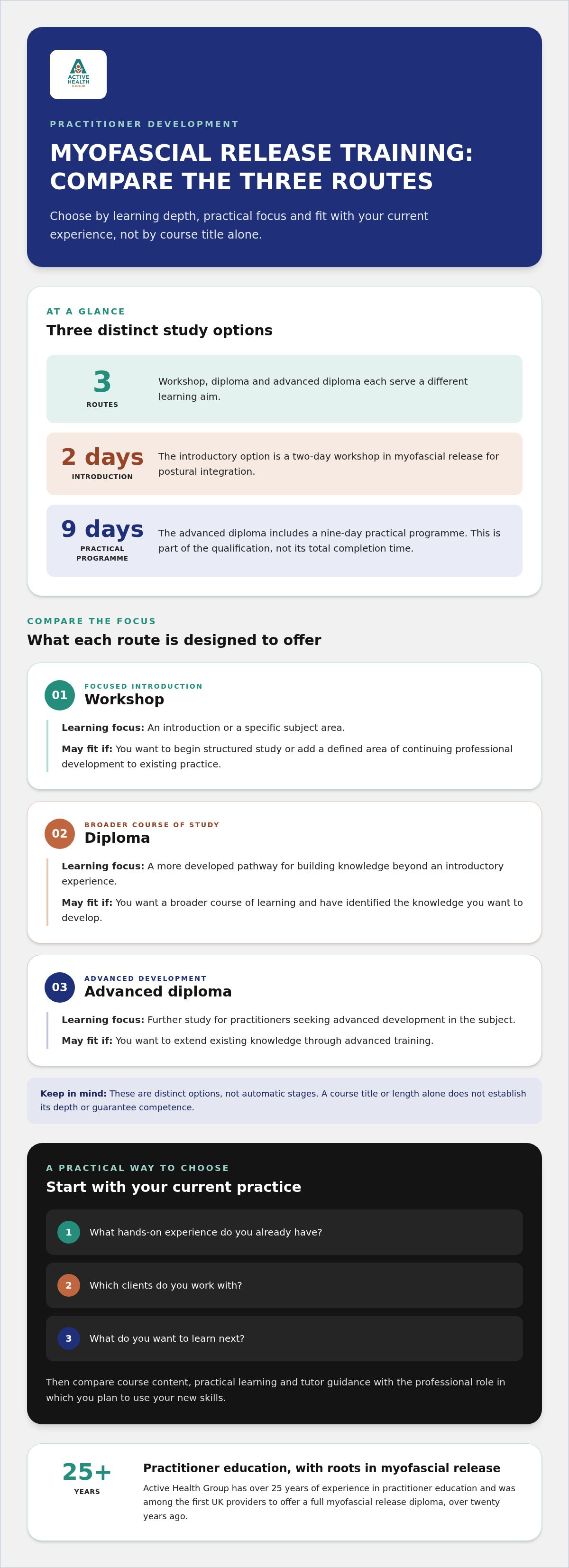
The longest myofascial release training route isn’t automatically the right place to begin. If course titles make it difficult to judge the depth of study, you’re not alone: a workshop and a diploma can serve different professional needs.
The right choice depends on your hands-on experience, the skills you want to develop and how you plan to apply them in your work. This article compares workshop, diploma and advanced diploma study, with practical criteria to help you choose. Active Health Group is a not-for-profit organisation with over 25 years of experience in practitioner education. Its myofascial release training includes a two-day introduction, diploma pathways and a nine-day practical programme within the advanced diploma. Use the comparisons below to match your next step to your current practice and continuing professional development goals.
Table of Contents
Myofascial release training: what should practitioners look for?
Myofascial release is a form of manual therapy that uses pressure and touch to work with fascia, the connective tissue surrounding and linking structures in the body. A general overview of Myofascial Release can help explain the method, but a technique description alone won’t tell you how thoroughly a course teaches it.
A method’s description explains what the technique involves; it doesn’t establish the depth of practical learning, tutor guidance or feedback a course provides. To compare options, look at the course content, how much practical learning it includes and how the teaching relates to your professional role.
How can you judge whether training fits your practice?
Begin with three questions: What hands-on experience do you already have? Which clients do you work with? What do you want to learn next? A massage therapist may want to add a distinct approach to existing sessions, while a more experienced practitioner may be looking for broader study of assessment and treatment planning. Your answers help you choose a suitable level of study.
When comparing courses, look for a clear connection between the concepts taught and their practical application. Consider whether the learning helps you understand the method, practise relevant skills and reflect on how an approach fits your professional role. For example, you might want to learn how myofascial release could complement an existing session plan, rather than simply collect another technique.
Compare the subject areas covered, practical components and tutor guidance. Active Health Group’s not-for-profit myofascial release training options offer a starting point for matching focused study to your current experience and continuing professional development needs.
Workshop or diploma: which myofascial release training route fits?
Course titles can indicate the type of study, but they don’t show exactly how the learning will translate into practice. Compare each route’s purpose, practical focus and fit with your next professional development goal.
Use these descriptions as comparison points, not as guarantees of competence. The National Association of Myofascial Trigger Point Therapists provides information about training programmes. For your own decision, consider your learning aims, current experience and the professional context in which you intend to use new skills.
When might a workshop or diploma be the more suitable next step?
A workshop can provide a structured introduction to myofascial release and help you consider how the subject relates to your current work. If your aim is focused introductory learning, explore AHG’s myofascial release workshop.
Diploma-level study may suit practitioners looking for a broader course of learning. Compare the content and practical focus with the knowledge you want to develop. A course title or length alone does not show how well a programme fits your professional goals. Explore AHG’s myofascial release training to compare the available routes.
Progress from myofascial release training to advanced study with AHG
Practitioner development can move from an introduction to more sustained study, depending on your experience and aims. Active Health Group offers a workshop, diploma and advanced diploma as distinct training options. They are not automatic stages, so choose the route that best fits your current practice and the skills you want to develop.
AHG was among the first UK providers to offer a full myofascial release diploma, over twenty years ago. Its training options give practitioners different ways to develop their knowledge of the subject.
What does AHG's myofascial release training pathway include?
The introductory option is a two-day introduction to myofascial release for postural integration. Practitioners looking for a broader course of study can consider the myofascial release diploma. The advanced diploma includes a nine-day practical programme, which forms part of the qualification rather than indicating the total time needed to complete it.
To identify your next step, consider whether you need a structured introduction or want to build on existing knowledge through more advanced study. Explore AHG’s myofascial release training and compare the options with your professional goals.
Choose a learning route that supports your next step
Connect further study with the work you want to do. Before choosing, note the skills you want to strengthen, the experience you already have and how you hope to apply what you learn. These points give you a practical basis for comparing myofascial release training options, rather than choosing by title alone.
You may want an introduction before taking on deeper study, or a structured qualification that supports your continuing professional development. Active Health Group is a not-for-profit organisation focused on practitioner education, with myofascial release training routes for different stages of development.
Take time to compare the available options against your experience and intended direction. Explore AHG’s myofascial release training and choose a route that supports your next professional step.
Frequently Asked Questions
What is fascia, and how does it relate to myofascial release?
Fascia is connective tissue arranged in layers throughout the body, supporting and linking structures such as muscles. Its continuity is relevant to hands-on work because practitioners consider how tissues relate across an area, rather than viewing each muscle in isolation. Anatomy knowledge can help you understand the tissues discussed in training and communicate clearly about the approach.
Is myofascial release training suitable for massage therapists?
Yes, massage therapists can consider myofascial release training as professional development relevant to hands-on practice. Start by identifying what you want to add, such as a different approach to working with a client who describes local tension, or a broader understanding of tissue relationships. Choose study that builds on your existing skills and supports your professional development goals.
What is the difference between myofascial release and trigger point therapy?
Myofascial release generally uses broader, sustained contact with fascia and surrounding tissues, while trigger point therapy focuses more directly on specific sensitive points within muscle. The approaches can overlap in hands-on practice, but their emphasis differs. Knowing that distinction helps you clarify what a technique focuses on and what further study you may need.
How long is AHG's advanced myofascial release practical programme?
AHG’s advanced diploma includes a nine-day practical programme. This refers to the practical programme, not necessarily the total time required to complete the qualification. If you’re planning study alongside client work, include the practical component in your study planning and consider how it fits your professional development goals.


This is a helpful breakdown of the different training options, especially for practitioners deciding where to start. For a bit of downtime after reading, I sometimes play Stickman Hook since it’s simple to pick up and a fun way to relax.