


Health Coach vs Wellness Coach: Key Career Differences

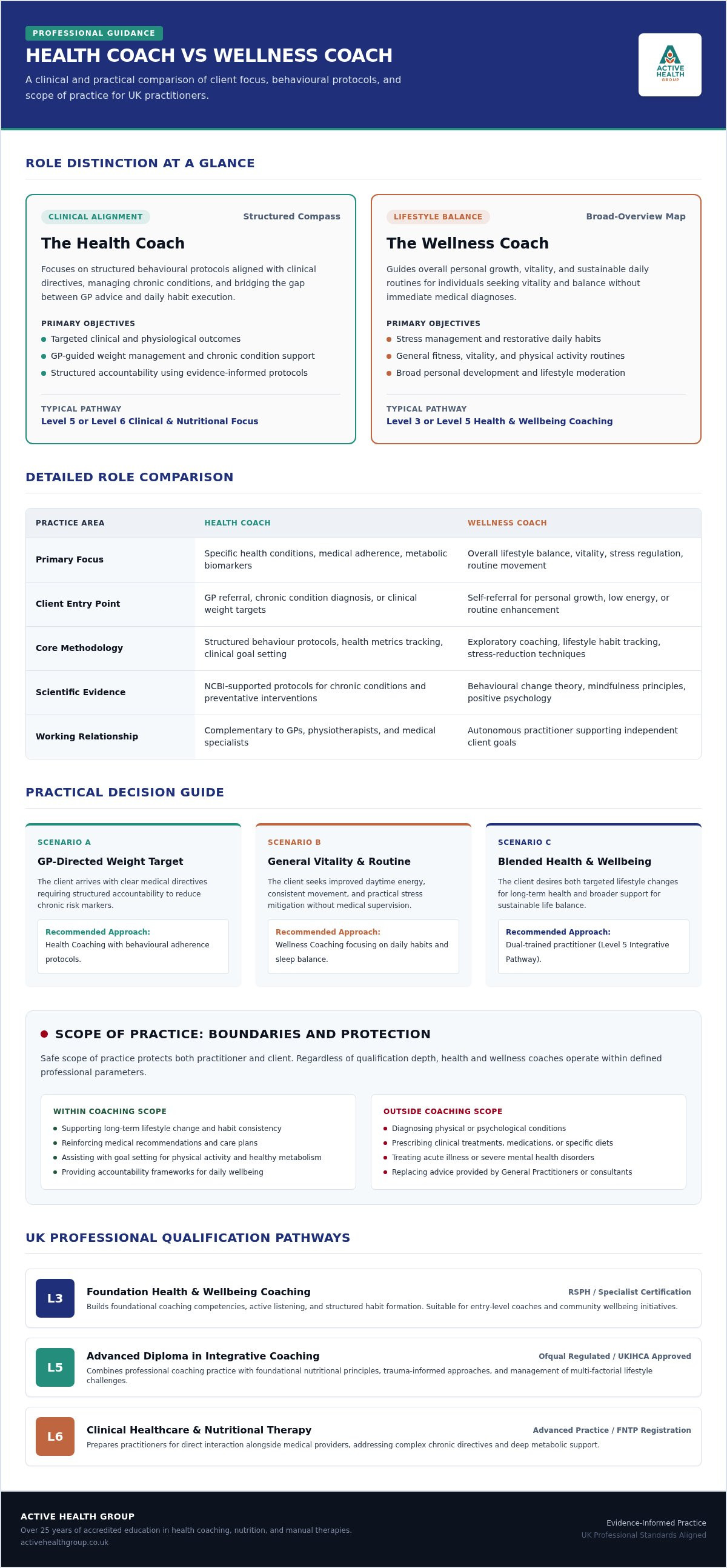
Understanding the Health Coach vs Wellness Coach choice starts with how you want to work with clients day to day. While health coaches focus on clinical targets and lifestyle interventions for specific medical conditions, wellness coaches support broader personal growth, stress management, and general wellbeing. Professional UK training for either path varies depending on accreditation standards.
Key Takeaways: Health coaches focus on clinical targets and medical-plan adherence, while wellness coaches support broader personal growth, stress management, and general lifestyle balance.
Health coaching suits clinical targets like losing weight through structured 2011 NCBI-supported behavioral protocols.
Except when clients require medical diagnosis or treatment for acute illness or severe mental health.
Choose wellness coaching for general fitness goals and health coaching for managing chronic medical directives.
Active Health Group evidence shows Level 6 clinical training enables direct referrals from general practitioners.
Table of contents
Match your coaching path to the clients you want to serve
Health coaching suits clinical targets, whilst wellness coaching fits broad lifestyle improvements. With clients we see that specific health markers require structured behavioural interventions. Training programmes must provide sufficient depth to handle these complex needs safely.
Three situations show how the choice plays out in practice:
A client arrives with GP-led weight targets and needs structured accountability: train toward health coaching so you can run behavioural protocols alongside medical care.
A client wants better energy, stress balance and routine movement without a clinical diagnosis: wellness coaching gives you the breadth to work on lifestyle as a whole.
You want the flexibility to handle both clinical goals and wider habits: a deeper qualification such as the Level 5 wellness programme builds skills for complex client scenarios.
Your choice shapes your career path and daily client work. Broad lifestyle support needs less formal clinical structure. Conversely, managing chronic conditions demands structured education.
Your budget also guides this decision. Specialised clinical training requires a larger investment than basic wellness courses. Request a personalised quote for exact figures.
Target health coaching for clinical goals such as losing weight (weight management). Choose wellness coaching when the brief is general fitness and wider lifestyle balance. Align your choice with your professional goals so client work stays focused and effective.
What is a health coach?
A health coach is a trained professional who guides clients to adopt sustainable behaviour changes for physical and mental wellbeing.
In practice, practitioners see that clients often struggle to bridge the gap between medical advice and daily lifestyle habits. Professional training helps coaches structure these lifestyle interventions safely. For example, the Level 3 Men's Health and Wellbeing Coaching Course from professional health coach training, developed in association with leading men's charity Mentell, provides a structured framework for supporting client change.
According to research published by the NCBI in 2011, clinical integration of health coaching improves management of chronic conditions through goal setting and accountability. Coaches help individuals with losing weight and increasing exercise and movement (physical activity). This approach complements medical care.
Accessing private health support alongside standard care can present administrative hurdles for clients. On pistonheads.com, one participant posted in the discussion titled "Company private medical, Worth doing, and who with?, Business":
"The most irritating thing about private health insurance is that you generally need to get a referral from your NHS GP before the private insurer will start their consultation. Which can be an inconvenience for both you and your GP." (source)
Private insurance friction often delays lifestyle interventions, making direct access to qualified health coaches an efficient alternative for preventative care.
Health Coach vs Wellness Coach: where the roles diverge
Health coaches target specific clinical conditions, whereas wellness coaches focus broadly on overall lifestyle balance.
In practice, health coaches help clients manage ongoing medical directives and lose weight. Wellness coaches look at stress, energy, and routine movement habits. Choosing between them depends on your specific focus.
Certain professionals blend both skill sets to deliver well-rounded assistance. Completing a Level 5 coaching pathway helps practitioners address both clinical goals and broader lifestyle habits effectively.
Health coaching operates as a structured intervention: think of it as a precise compass, whereas wellness coaching resembles a broad-overview map.
Focusing on client needs guides a sound decision and supports clearer care. Which path suits you depends on whether you prefer clinical targets or wider lifestyle work.
Safe scope of practice protects you and your clients
Coaches must never diagnose conditions, prescribe treatments, or replace medical advice. From practitioner observation, boundaries protect both the coach and the client. Referring complex medical issues to doctors ensures safe care.
A clear scope acts like a fence on a field: it keeps your practice safe and signals professionalism that builds long-term trust.
Investing in accredited Health Coaching through Active Health Group ensures you learn these vital legal frameworks. Safe boundaries create successful practices, and understanding these professional limits builds the practical confidence that clients notice in everyday sessions.
Tip: Maintain strict data protection protocols and recognised GDPR compliance when managing client personal and health records.
Among Active Health Group's Google reviews, one long-term graduate (5★) wrote:
"I trained to Level5 with AHG 11 years ago and continue to do cpds and other courses with them as like others have said the content and the variety of courses are very good with great support and i have friends who have since trained there too. Keep going guys."
Long-term experience with accredited training providers reinforces the importance of safe practice boundaries and continuous professional development.
How can I become a health coach?
You become a qualified practitioner by completing an accredited training programme that provides formal credentials and practical skills. Securing industry credentials requires structured study and real placement work.
Select a recognised programme: Choose a qualification like the RSPH Level 3 Health Coaching Course or the Focus Awards Level 5 Certificate in Coaching for Health and Wellbeing (RQF).
Master foundational theory: Study core modules covering behaviour change, nutrition, and mental wellbeing.
Complete practical placements: Apply your skills in professional environments with live clients.
Obtain professional accreditation: Register with an accredited industry body upon course completion.
In our student placements, we saw how crucial steady mentoring is for building confidence. Situation: an Active Health Group student felt deeply anxious before attending her first live placement. Solution: steady mentoring and reassurance during the placement. Result: she developed confidence and competence, later building a long-term career in professional sport. Guidance turns uncertainty into success.
Balancing full-time commitments while studying can feel challenging. Studying online offers flexible progression pathways that fit around your current schedule. Structured tutor support helps you stay on track toward your goals. Book a guidance call with a tutor today to discuss your training pathway.
Certification costs, career returns and earnings pathways for UK practitioners
Your initial qualification investment and ongoing insurance fees directly shape your earning potential as a UK practitioner.
In our practitioner training, we notice that clear pricing structures build early commercial confidence. Investing in higher clinical levels yields stronger career returns: wider client scope, specialist referrals, and the standing to work at premium private rates.
According to current UK industry standards, basic insurance and course fees vary depending on the qualification level. Higher certification levels allow you to charge premium private rates or accept specialist referrals. For exact course fees, request a personalised quote.
Broad recommendations frequently leave practitioners overwhelmed whenever complicated client scenarios arise. Situation: a practitioner needed deeper clinical training for complex client work. Solution: they completed the Level 6 Clinical Nutrition Course with Active Health Group. Result: transitioning to a full clinical practice enabled them to take direct referrals from general practitioners, expanding both client scope and practice outcomes.
Health coaches often build private client portfolios, while wellness coaches frequently secure corporate contracts. Non-monetary returns from deeper training include clearer professional confidence, stronger referral relationships with GPs, and the flexibility to move between private and organisational settings. Before making your financial plan, contact your provider for precise course costs.
If you worry about recouping your initial study investment, higher qualification levels command higher hourly fees and open specialist pathways that basic courses do not.
Forum discussions on benefits and work also show why recognised credentials and insurance matter when health disrupts employment. A commenter in the benefitsandwork.co.uk thread "Unum I'll health insurance, Forum, Benefits and Work":
"Hi, unfortunately due to SS I'm now unfortunately unable to work due to I'll health and the company I'm leaving have told me to contact unun insurance company for I'll health payment." (source)
When health issues prevent you from working, having recognised qualifications and proper professional insurance helps you navigate career transitions or claim appropriate policy benefits safely.
When a life coach or medical provider is the better fit
Direct medical care is required whenever you experience undiagnosed physical symptoms, acute illness, or severe mental health conditions.
Coaching is never a substitute for clinical diagnosis or treatment. Medical doctors handle complex pathologies, while a life coach focuses on general personal goals, mindsets, and broader career shifts.
If you need medical treatment, a coach must refer you to a qualified practitioner immediately. Active Health Group trains practitioners to recognise these professional boundaries clearly, so client safety stays the priority.
Understanding your exact scope of practice prevents harm. Think of a health coach as a personal navigator for daily habits, whereas a doctor is the emergency mechanic fixing a broken engine.
Knowing when to refer clients protects everyone involved. For practitioners, mastering these referral pathways builds professional confidence. Choosing the right support path depends on whether a client needs clinical intervention or lifestyle guidance: clinical conditions require licensed medical experts.
Frequently asked questions
What is a health coach?
A health coach is a trained professional who helps you create sustainable lifestyle habits through evidence-informed guidance. They focus on behaviour change, helping you manage stress, improve nutrition, and build consistent routines.
What does a health coach do?
A health coach works with you to identify personal wellness goals and build realistic action plans. They provide accountability, educational support, and practical strategies to support your daily well-being.
How can I become a health coach?
You can become a health coach by completing a recognised training course that teaches behavioural coaching techniques and lifestyle science. Qualified training helps you build practical coaching skills and professional confidence. Structured placements and mentoring, as used on Active Health Group programmes, support the step from study into live client work and longer-term career paths such as professional sport.
How do I choose a health coach?
Match the coach’s training depth and focus to your goals: clinical targets and medical-plan support point toward a health coach, while stress, energy and general lifestyle balance point toward a wellness coach. Check for accredited UK qualifications (for example RSPH Level 3 or Focus Awards Level 5), clear scope-of-practice boundaries, and a willingness to work alongside your GP rather than replace medical care.
How is a health coach different from my other healthcare providers?
A health coach provides continuous lifestyle support and accountability rather than medical diagnosis or treatment. They work alongside medical doctors to help you implement long-term health recommendations. You can explore structured education options like the Level 3 Men's Health and Wellbeing Coaching Course from Active Health Group, which was developed in association with the leading men's charity Mentell.
Next steps for your coaching career
Choosing between a health coach vs wellness coach path depends on your target clients. Health coaches focus heavily on practical lifestyle changes, including losing weight and structured movement habits. Wellness coaches often take a broader view of lifestyle habits.
Active Health Group has delivered accredited practitioner education across the UK for over twenty years. Our founder, Richard Johnson, brings over a quarter of a century working in therapy to our qualification programmes.
Ready to advance your skills in 2026? Explore our ADHD Coaching Course to start your learning. Contact our team to discuss your training options or ask for course figures that match your pathway.


This was a helpful read, especially the part about how the two coaching roles differ. When I have some free time, I like playing Rocket Goal for a bit since it’s a fun way to relax and clear my head.