.png)


Health Coach vs Nutritionist: Which Career Suits You?

If you could help a client transform their health, would you rather focus on the biological science of what is on their plate or the behavioural psychology of how they get it there? Choosing between the roles of a Health Coach vs Nutritionist often feels like a fork in the road, especially when UK regulations seem unclear. You likely want to ensure your practice remains ethical and effective without the fear of overstepping professional boundaries.
By understanding the specific distinctions in scope and training, you can select the qualification that matches your long-term career goals. This article provides a clear roadmap through the professional requirements of both fields. You will learn the practical differences between Level 5 and Level 6 qualifications alongside the reality of the current job market. We also provide a framework for establishing a private practice with confidence and clinical integrity.
Table of Contents
Defining the Professional Roles: Health Coach vs Nutritionist
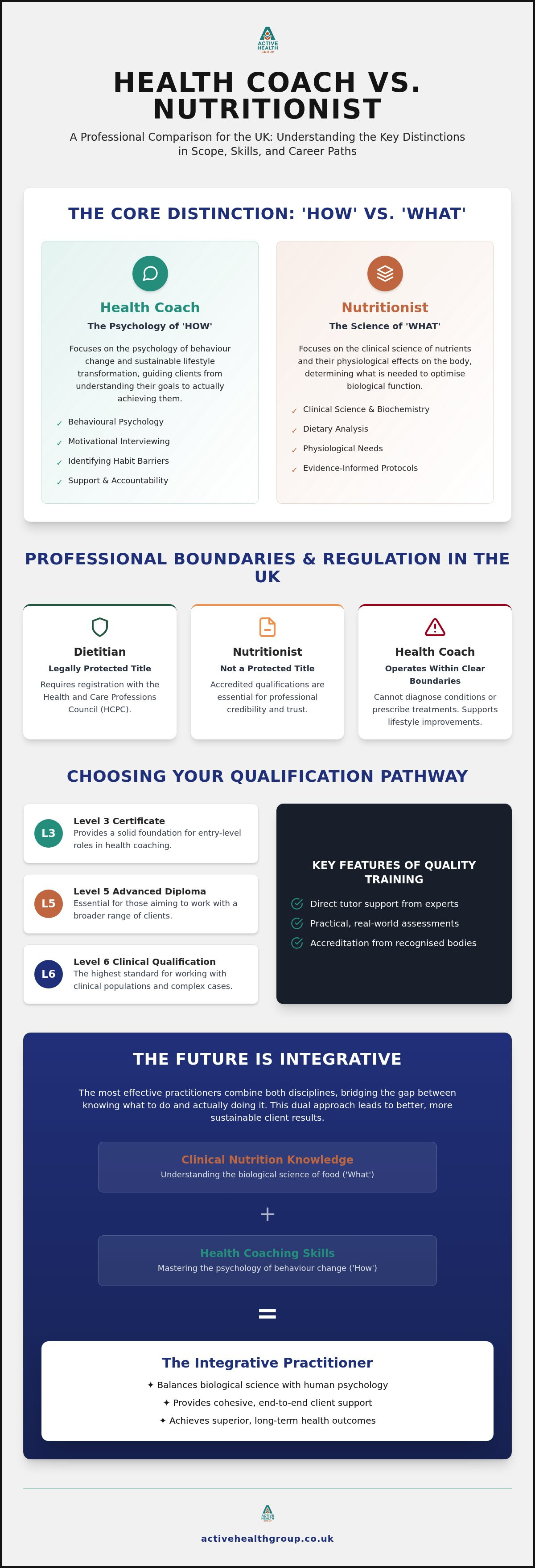
The choice between becoming a Health Coach vs Nutritionist depends on where you want to apply your expertise. A nutritionist focuses on the clinical science of nutrients and their complex physiological effects on the human body. They identify the "what" of a client's health, determining which specific foods or nutrients are required to optimise biological function. If you are asking What is a Nutritionist?, it's helpful to view them as specialists in biochemistry and dietary analysis who provide evidence-informed protocols to address physiological needs.
In contrast, a health coach specialises in the psychology of behaviour change and sustainable lifestyle transformation. Their expertise lies in the "how". They guide clients from a state of understanding their health goals to a state of actually achieving them. This involves motivational interviewing and identifying the psychological barriers that prevent people from maintaining healthy habits. While the nutritionist provides the scientific roadmap, the health coach provides the support and accountability needed to follow it.
Scope of Practice and Professional Boundaries in the UK
In the UK, the title "Dietitian" is legally protected and requires registration with the Health and Care Professions Council. However, the title "Nutritionist" is not legally protected, which makes choosing an accredited qualification essential for professional credibility. Health coaches must operate within clear boundaries. They support lifestyle improvements but cannot diagnose conditions or prescribe treatments for chronic diseases. For a detailed look at these standards, you can read our guide on is health coaching a regulated profession UK. Practitioners who respect these boundaries protect both their clients and their own professional reputation.
Comparing Career Paths: Skills, Education and Day-to-Day Practice
While both roles aim to improve wellness, the daily reality of a Health Coach vs Nutritionist differs significantly. A professional on a Nutritionist Career Path focuses on data-driven assessments, such as reviewing biochemical markers or conducting detailed dietary analysis to create evidence-based meal plans. Conversely, a health coach spends their hours in dialogue, utilising motivational interviewing to help clients identify barriers to change and set achievable goals.
Career opportunities are expanding across the UK. Practitioners find success in private practice, corporate wellness programmes, or within the NHS as part of personalised care teams. Many choose to progress from foundational roles to clinical environments by pursuing advanced training that allows for a broader scope of practice.
Choosing the Right Qualification Level for Your Goals
Selecting a course depends on your intended professional standards. A Level 3 Health Coaching certificate provides a solid foundation for entry-level roles, but a Level 5 or Level 6 qualification is essential for those wishing to work with clinical populations or complex cases. Higher-level diplomas offer the depth required to understand the integration of nutrition and psychology safely. When evaluating providers, ensure they offer:
Direct tutor support from experienced practitioners rather than just automated content.
Practical assessments that mirror real-world consultations.
Accreditation from recognised bodies such as the UKIHCA.
For those seeking the highest standards of clinical readiness, our Level 6 Diploma in Health Coaching and Clinical Nutrition provides a comprehensive professional pathway.
The Integrative Approach: Why Combining Both Disciplines is the Future
Clients often struggle to implement nutritional advice because of deep-seated psychological barriers. A specialist nutritionist may provide a scientifically sound protocol, but they are often not trained to manage the emotional triggers or habit loops that lead to non-compliance. Integrative practitioners provide a more cohesive experience by addressing food choices and behaviour change simultaneously. This dual approach bridges the clinical gap between knowing what to do and actually doing it. As outlined in this comparison of Health Coach vs Nutritionist pathways, the most effective practitioners are those who can balance biological science with human psychology.
Active Health Group specialises in this dual-skill approach. With over 25 years of experience in practitioner education, we focus on producing graduates who are ready for the complexities of modern wellness practice. Understanding the nuances of the Health Coach vs Nutritionist roles allows you to see why an integrated model is becoming the industry standard. Our not-for-profit status ensures that student outcomes and professional integrity remain our primary priorities.
Starting Your Career as an Integrative Health and Nutrition Coach
For career changers, the Level 5 Advanced Diploma in Integrative Health and Nutrition Coaching serves as an ideal entry point. It provides the professional standards required for ethical practice whilst remaining accessible to adult learners. To stand out in a crowded market, gaining advanced clinical depth through a Level 6 Clinical Nutrition course allows you to work with complex cases that require higher levels of biochemical understanding.
Launching a private practice within your first year is achievable with a logical roadmap. Start by securing professional insurance and joining an accredited body to establish credibility. Focus on a specific niche where your integrative skills solve a clear problem for your target audience. This structured progression from student to practitioner ensures a stable foundation for long-term career success.
Building Your Future in Integrative Health
Deciding between the path of a Health Coach vs Nutritionist requires a careful assessment of your professional strengths and long-term goals. Success in this field involves more than just acquiring a certificate; it demands a deep commitment to evidence-informed practice and a clear understanding of your clinical boundaries. By choosing a qualification that integrates behaviour change with nutritional science, you prepare yourself to meet the diverse needs of your future clients with integrity.
Active Health Group brings over 25 years of experience to your training, offering a practitioner-led curriculum designed for real-world readiness. Our not-for-profit status ensures that our focus remains on your professional success and high ethical standards. Explore our accredited Level 5 and Level 6 qualifications to start your career in integrative health. You are ready to take the next step towards a rewarding and impactful professional practice.
Frequently Asked Questions
Can I call myself a nutritionist if I have a health coaching diploma?
You should only use titles that accurately reflect your specific training and insurance coverage. While the title "nutritionist" isn't legally protected in the UK like "dietitian" is, using it without a dedicated nutrition qualification can be misleading. It is better to use a title such as "Integrative Health and Nutrition Coach" to maintain professional integrity and ensure your clients understand your specific scope of practice.
Do I need a university degree to work as a nutritionist in the UK?
You don't need a university degree to work in private practice or the wellness industry. Vocational qualifications, such as a Level 5 or Level 6 Diploma, provide the clinical depth and practical skills required to support clients safely. While a degree is necessary to become a "Registered Nutritionist" with the Association for Nutrition, vocational pathways are often preferred by those seeking a career in private practice.
What is the average salary for a health coach vs a nutritionist in the UK?
The national average salary for a health coach is approximately £28,467, with NHS roles for qualified practitioners often ranging between £32,073 and £38,308. Private sector nutritionists typically start between £20,000 and £25,000, while senior roles can reach £55,000. In the Health Coach vs Nutritionist market, many choose self-employment, where private coaching rates often range from £60 to £150 per hour depending on experience.
Is it better to study nutrition or health coaching first?
Your choice depends on whether you prefer focusing on biological science or behavioural psychology. If you enjoy biochemistry, a nutrition qualification provides a strong clinical base. However, many students find that starting with health coaching is beneficial because it teaches the behaviour change skills necessary to help clients implement nutritional advice. An integrative course that combines both disciplines is often the most efficient pathway for modern practice.


Comments