.png)


Professional Myofascial Release Courses: UK Training

A single weekend workshop rarely provides the clinical depth needed to resolve complex, long-term chronic pain. You likely recognise that your clients are presenting with increasingly intricate physical issues that standard massage techniques cannot quite reach. It's frustrating to invest in myofascial release courses only to leave feeling confused about the difference between direct and indirect methods or unprepared for real-world clinical applications.
This guide explores how to identify high-quality training that offers professional accreditation and the practical skills required for a sustainable practice. We will examine the standards of professional training in the UK, moving from introductory workshops to advanced diplomas, ensuring you choose an educational pathway that delivers genuine results for your clients. By focusing on evidence-informed practice and rigorous clinical standards, you can build the confidence to treat even the most challenging cases effectively whilst maintaining the highest levels of professional integrity.
Table of Contents
Understanding Professional Standards for Myofascial Release Training
Myofascial Release is a precise clinical method focusing on the body's connective tissue system to alleviate chronic pain and restore mobility. Unlike general massage, it requires a deep understanding of how fascial manipulation influences the nervous system. When researching professional myofascial release courses, verifying accreditation with recognised UK professional bodies is the first step towards ensuring clinical safety. With the UK complementary medicine market projected to grow at a compound annual growth rate of 26.2% through to 2033, this verification is essential for securing professional indemnity insurance and maintaining high ethical standards within your practice.
Clinical rigor ensures you understand the physiological changes occurring under your hands. Effective treatment relies on understanding the neurological response to sustained touch rather than simply applying pressure. Professional training provides the framework to assess these responses accurately, allowing you to move from basic application to advanced clinical reasoning.
Why choose a diploma over a short workshop?
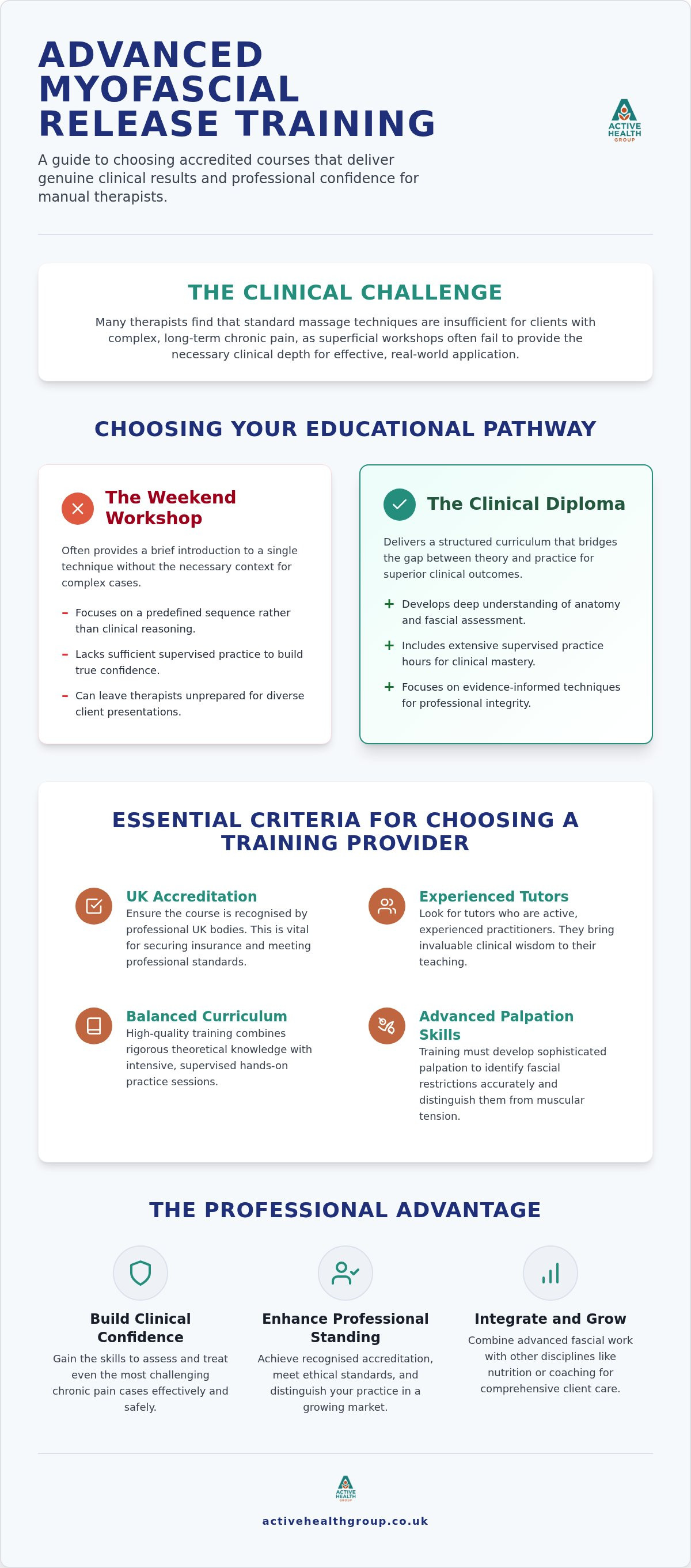
Whilst short workshops are useful for learning a specific technique, comprehensive myofascial release courses should provide a deeper understanding of the body's interconnected systems. A myofascial release diploma delivers a structured curriculum that bridges the gap between theory and practice. Active Health Group has spent 25 years refining these pathways to include:
Detailed functional anatomy and fascial assessment protocols.
Treatment planning for long-term clinical outcomes.
Extensive supervised practice hours to ensure practitioner confidence.
Integration of evidence-informed techniques for professional practice.
Building these skills takes time. A diploma provides the necessary supervision to ensure you're ready for the weight of professional responsibility. It transforms your approach from a series of techniques into a cohesive clinical strategy that serves the complex needs of your clients.
Evaluating Myofascial Release Courses for Clinical Practice
High-quality training goes beyond teaching a simple sequence of strokes. It must empower the therapist to select between direct and indirect techniques based on a client's specific presentation. This person-centred approach is a core component of CNHC professional standards, ensuring that practitioners operate within a framework of safety and clinical excellence. Sophisticated palpation skills are vital. You need to identify fascial restrictions without causing unnecessary discomfort, which requires a nuanced understanding of tissue feedback and the ability to detect subtle changes in density.
Robust myofascial release courses should also include detailed assessment protocols. It's essential to distinguish between muscular tension and genuine fascial dysfunction to provide effective care. Without this diagnostic depth, treatments may lack the precision required for complex chronic pain cases. Practitioners must be able to justify their clinical choices through objective assessment rather than relying on intuition alone.
Essential criteria for choosing your training provider
Selecting the right institution is a significant professional decision. You should look for training that meets these specific criteria:
Tutors who are active practitioners with extensive clinical experience.
A balanced curriculum combining rigorous theoretical study with intensive hands-on sessions.
Sustained support through mentoring or access to an online academy after graduation.
Comprehensive focus on myofascial trigger points to ensure a complete therapeutic toolkit.
Active Health Group has spent two decades developing these standards to support the next generation of therapists. If you are ready to advance your clinical skills, exploring a specialist workshop can be an excellent starting point for professional growth.
Advancing Your Career with Specialist Fascial Training
Specialising in fascia allows therapists to move beyond surface-level symptom management. By addressing the root causes of persistent physical tension, you can offer unique services that distinguish your practice in a competitive market. Advanced practitioners often find that fascial work integrates well with other professional disciplines. Combining manual therapy with clinical nutrition or health coaching provides a more comprehensive support system for clients dealing with long-term health challenges.
Choosing a not-for-profit training provider ensures that the focus remains on your professional growth. Active Health Group has spent 25 years prioritising student success and ethical standards. This practitioner-led mentorship provides the stability and depth required to build a reputable practice. When you invest in myofascial release courses, you adopt a clinical philosophy that values evidence-informed care and person-centred results.
The pathway from foundation to advanced practice
Building expertise requires a structured approach to learning. Most therapists start with a myofascial release workshop to understand core principles and basic techniques. This foundation allows you to apply new skills immediately whilst preparing for more complex studies. To master intricate clinical applications, you can then progress to an advanced myofascial release diploma. This progression ensures you develop the necessary palpation skills and clinical reasoning at a manageable pace.
Understanding the wider professional context is equally important. If you intend to integrate coaching into your manual therapy business, it is helpful to read our guide on is health coaching a regulated profession in the UK. This knowledge ensures you maintain clear professional boundaries and adhere to current standards within the integrative health sector.
Developing Your Clinical Specialism in Fascia
Selecting the right educational pathway is a critical step in your professional development. By choosing accredited myofascial release courses that prioritise clinical depth, you ensure your practice remains safe, ethical, and effective for clients with complex needs. Moving from basic workshops to advanced diplomas allows you to build sophisticated palpation skills whilst gaining the confidence required for professional practice.
Active Health Group provides a stable foundation for this growth. As a not-for-profit organisation with over 25 years of experience in therapist education, we prioritise high standards and student success. You'll receive tutor-led support throughout your training, ensuring you master the practical application of these techniques. If you're ready to enhance your clinical results and build a sustainable career, view our accredited myofascial release courses and start your clinical training today. We look forward to supporting your progress in this rewarding field.
Frequently Asked Questions
What is the difference between direct and indirect myofascial release techniques?
Direct techniques involve sinking into the fascial layers to move through restrictions with firm pressure. Indirect methods use a much lighter touch to follow the tissue's natural ease, allowing the nervous system to release tension. Most comprehensive myofascial release courses teach both approaches. This ensures you can adapt your clinical strategy to suit the client's sensitivity and the specific nature of their restriction.
How long does it take to become a certified myofascial release practitioner in the UK?
The duration depends on the level of qualification you seek. A foundational workshop typically takes two days, whilst a full diploma usually spans several months to allow for supervised practice and case studies. For those pursuing an advanced diploma, the process involves deeper clinical assessments and refined palpation skills. It's essential to allow sufficient time to integrate these skills before treating complex chronic pain cases professionally.
Are myofascial release courses suitable for beginners or only for experienced therapists?
Most professional training requires a foundational Level 3 qualification in a manual therapy such as sports or remedial massage. This ensures you have the necessary anatomy and physiology knowledge to apply fascial techniques safely. Whilst some introductory workshops are accessible to those starting their careers, advanced myofascial release courses are designed for practitioners who already understand basic soft tissue manipulation and clinical assessment protocols.
Can I practice myofascial release professionally after a weekend workshop?
You can often gain insurance to practice specific techniques after an accredited two-day workshop. However, a single weekend rarely provides the clinical depth required to manage complex chronic pain. Building a sustainable professional practice usually involves progressing through a structured curriculum. This pathway moves you from basic application to a deeper understanding of fascial science, ensuring you can provide consistent results for your clients safely.


I like the short challenge format of Drive Mad. It doesn't take long to understand the controls, while the obstacle layouts still keep things interesting.