.png)


Clinical Nutrition Course with Practical Assessments: A Professional UK Guide for 2026
- Richard Johnson

- 17 hours ago
- 12 min read
What if the most significant barrier to your professional success isn't a lack of knowledge, but the absence of supervised clinical experience? Many students find themselves overwhelmed by generic wellness courses that lack depth, leaving them fearful of seeing clients once they graduate. Choosing a clinical nutrition course with practical assessments is the essential bridge that moves you from being a student of theory to a practitioner of science. This structured approach ensures you meet UK professional standards whilst gaining the hands-on skills required to handle complex health cases with integrity.
You likely recognise that building a credible career requires more than just a certificate; it demands a deep commitment to evidence-based practice and ethical conduct. This guide explores how to transition from academic study to professional practice by focusing on a Level 6 Diploma that prioritises clinical readiness. We will outline the journey of mastering assessment techniques and the practical steps needed to launch a private practice with the confidence that only comes from rigorous, real-world testing in 2026.
Key Takeaways
Understand why a clinical nutrition course with practical assessments is vital for bridging the gap between theoretical nutritional science and real-world practitioner competency.
Learn how supervised clinical placements build the necessary confidence to manage complex cases involving multi-morbidity and diverse client needs.
Discover the advantages of a blended learning model, which combines the flexibility of online study with the essential rigour of face-to-face clinical training.
Identify the professional standards and accreditation bodies, such as the RSPH, that ensure your qualification is recognised and respected within the UK health sector.
Gain insights into the structure of a Level 6 Diploma designed to transition you from a student to a confident, ethically grounded private practitioner.
Table of Contents
What Defines a Quality Clinical Nutrition Course with Practical Assessments?
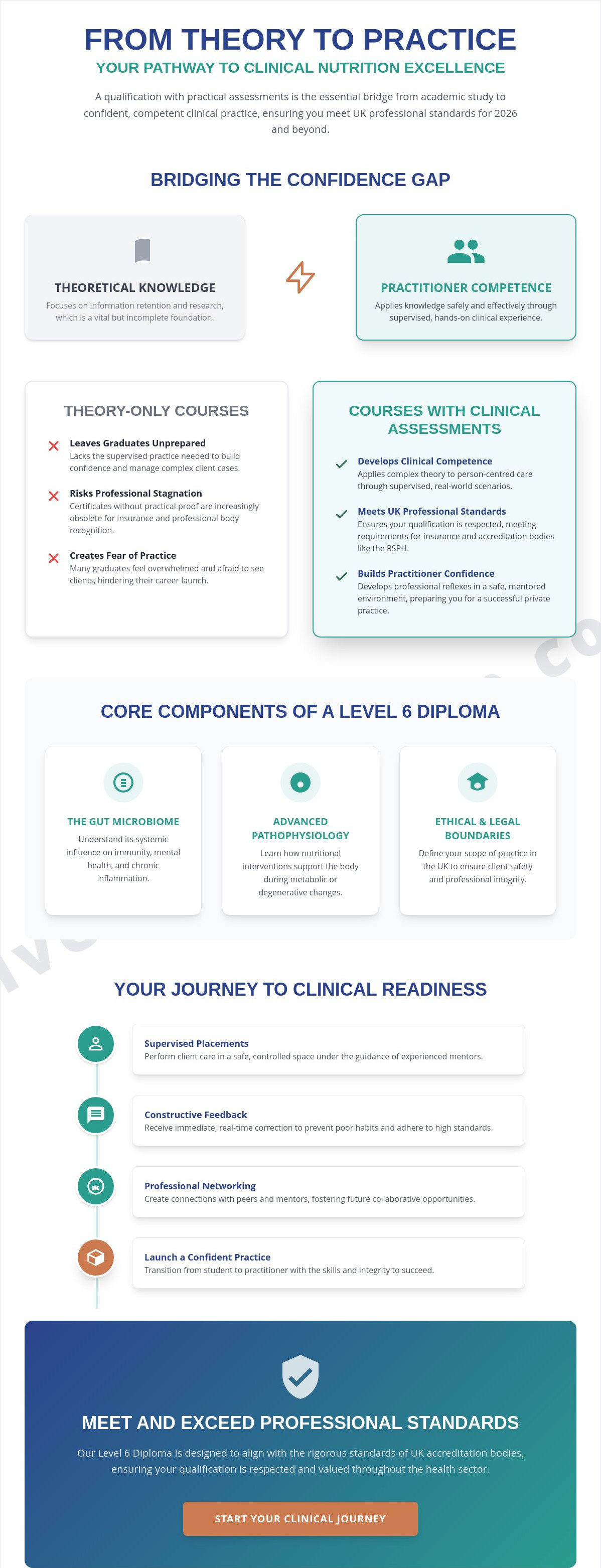
A high-calibre clinical nutrition course with practical assessments is defined by its ability to synthesise complex biochemical theory with the nuances of person-centred care. It isn't enough to understand the metabolic pathways of vitamin D or the impact of magnesium on the nervous system; a practitioner must be able to apply this knowledge safely and effectively within a clinical consultation. For those asking What is Clinical Nutrition?, it's the study of the relationship between food and a healthy body, specifically the prevention and management of disease through evidence-based dietary interventions.
As we move through 2026, the UK health sector is witnessing a significant shift. Whilst the title "Nutritionist" remains legally unprotected, the industry is self-correcting towards higher standards. Professional bodies and insurers now demand evidence of practical competency, making "theory-only" certificates increasingly obsolete. Choosing a clinical nutrition course with practical assessments ensures you are not just learning facts, but developing the professional reflexes needed to manage real people with real health challenges. These assessments act as the essential bridge, moving you from the safety of a textbook to the responsibility of a clinical setting.
The Difference Between Academic and Clinical Training
Academic study often prioritises information retention and research methodology. It's a vital foundation, yet it doesn't prepare you for the reality of a client sitting across from you with multiple health concerns. Clinical training focuses on the practical "how": interpreting biochemistry, conducting anthropometric measurements, and navigating the complexities of client behaviour. Practical validation is no longer optional; it's a non-negotiable requirement for professional insurance and accreditation from reputable organisations. Without it, you lack the objective proof that you can apply your knowledge without causing harm or stepping outside your professional boundaries.
Key Components of a Level 6 Curriculum
A comprehensive Level 6 Diploma in Clinical Nutrition must cover advanced pathophysiology. This involves understanding how micro and macronutrients interact with diseased or dysfunctional systems. The integration of science and skill is embedded within a clinical nutrition course with practical assessments, ensuring you master these key areas:
The Gut Microbiome: Understanding its systemic influence on immunity, mental health, and chronic inflammation.
Advanced Pathophysiology: Learning how nutritional interventions support the body during metabolic or degenerative changes.
Ethical and Legal Boundaries: Clearly defining your scope of practice in the UK to ensure client safety and professional integrity.
This level of study ensures you don't just "give advice". Instead, you provide structured, clinical interventions rooted in scientific rigour and professional ethics.
Why Hands-On Clinical Placements are Essential for Success
Theoretical knowledge is a necessary foundation, but it remains static until it's tested in a live environment. For many students, the leap from studying metabolic pathways to conducting a professional consultation feels daunting. This is why a clinical nutrition course with practical assessments is so vital. Supervised placements offer a safe, controlled space to build psychological confidence. You aren't just reading about client care; you're performing it under the guidance of experienced mentors who provide immediate, constructive feedback.
This real-time correction is invaluable. It prevents the development of poor habits and ensures you adhere to the high standards required for registration with the UK Voluntary Register of Nutritionists. Beyond skill acquisition, these placements foster a professional network. You'll work amongst peers and mentors, creating connections that often lead to collaborative opportunities or career guidance long after the course concludes. It's about moving from a state of learning to a state of professional belonging.
Mastering Client Intake and Assessment
Effective practice begins with the intake process. It's a delicate balance of technical inquiry and human rapport. During practical assessments, you'll learn to navigate thorough health histories without making the client feel like they are under interrogation. You'll also gain experience with modern health tracking technology and physical assessment tools. Clinical Assessment is the systematic collection of data to identify nutritional imbalances. Mastering this process ensures your subsequent recommendations are rooted in objective evidence rather than guesswork.
Navigating Complex Client Cases
Real-world clients rarely present with a single, isolated symptom. Most navigate complex, multi-morbidity cases where nutrition, lifestyle, and environment intersect. Placements allow you to move beyond "one-size-fits-all" advice toward truly personalised clinical protocols. For example, you might explore how chronic stress impacts metabolic health, a topic we cover in depth in our Burnout and Fatigue Clinical Training. Understanding these nuances is what separates a knowledgeable student from a competent practitioner. If you're ready to bridge the gap between theory and practice, exploring a Level 6 Diploma in Clinical Nutrition is your next logical step.
Comparing Training Formats: Online vs. Blended vs. In-Person
Selecting the right educational format is a pivotal decision that shapes your future competency as a practitioner. Whilst 100% online courses offer unparalleled convenience for theoretical modules, they often fall short in preparing students for the nuances of client care. Purely digital learning assumes you already possess the clinical "soft skills" required to manage a consultation. For those entering the field for the first time, a clinical nutrition course with practical assessments delivered through a blended model provides the most robust path to professional readiness. It ensures you don't just know the science, but can apply it under pressure.
Identifying "red flags" is essential when researching your options. Be cautious of programmes that promise clinical status or practitioner insurance without requiring any documented practical hours. In the professional health sector, competency cannot be validated through a multiple-choice screen alone. Live tutor support is another critical factor; having access to an expert to help you navigate complex biochemistry or pathophysiology is the difference between surface-level memorisation and deep, functional understanding.
The Blended Learning Advantage
The blended approach is designed for the modern adult learner, particularly those transitioning from a different career in 2026. This format allows you to study the demanding theoretical components at your own pace through an online academy, whilst attending intensive practical blocks in person. These physical sessions shouldn't be seen as an optional extra; they are the core of your professional development. They provide the structure needed to move from a state of learning to a state of doing, ensuring that your theoretical knowledge is anchored by physical clinical experience.
Validating Practical Competency
A rigorous clinical nutrition course with practical assessments will typically culminate in an OSCE (Objective Structured Clinical Examination) style assessment or a formal case study presentation. This process tests your ability to think on your feet and respond to client needs in real-time. Peer-to-peer practice in a controlled centre is vital for developing your clinical "voice" and refining your assessment techniques. This level of validation is what gives graduates the confidence to launch a private practice. If you are seeking a qualification that meets these high standards, our Level 6 Clinical Nutrition programme is specifically structured to provide this essential hands-on training.
Evaluating Professional Standards and Accreditation in 2026
In a market where "wellness" is often used as a vague catch-all, professional standards provide the necessary anchor for ethical practice. Choosing a clinical nutrition course with practical assessments ensures your training aligns with the rigorous expectations of the UK health sector in 2026. Accreditation from established bodies like the Royal Society for Public Health (RSPH) isn't just a badge of honour; it's a verification that your education meets specific benchmarks for safety, clinical depth, and evidence-based methodology.
Securing professional indemnity insurance is a critical step for any practitioner. Insurers often require evidence of supervised practice and objective assessment before granting coverage. A qualification backed by an institution with a 25-year history offers a level of stability and trust that newer, unproven academies cannot match. This longevity suggests a curriculum that has evolved alongside scientific advancements whilst maintaining a steadfast commitment to professional integrity. It's about ensuring your credentials carry weight with both clients and the wider medical community.
Professional Boundaries and Ethics
A clear understanding of your scope of practice is fundamental to professional success. Whilst a clinical nutritionist offers advanced nutritional support, they don't provide direct medical treatment or replace the role of a dietitian in a hospital setting. The "Do No Harm" principle dictates that you must recognise when a case requires a referral to a GP or specialist. Building a collaborative relationship with other healthcare professionals ensures an integrative approach that prioritises the client's long-term wellbeing. This ethical framework is what separates a true professional from a mere enthusiast.
Career Pathways Post-Qualification
Graduating is just the beginning of your professional journey. Whether you're launching a standalone private practice or integrating nutrition into an existing therapy business, success depends on your ability to acquire and retain clients through proven results. For those who don't yet hold a degree and are looking for a professional entry point, the Level 3 Health Coaching Foundation serves as an excellent starting point. It builds the core communication skills needed before advancing to more clinical specialisations. If you're ready to establish yourself as a credible practitioner, you can enrol in our Level 6 Diploma in Clinical Nutrition to begin your transition into professional practice.
The Active Health Group Approach to Clinical Excellence
At Active Health Group, we believe that professional education should be led by those who are active in the field. Our not-for-profit, practitioner-led model ensures that every module is designed with real-world application in mind. Rather than focusing on shareholder returns, we prioritise the integrity of the profession and the long-term success of our students. This philosophy is embedded within our Level 6 Diploma in Clinical Nutrition, providing a structured pathway that moves you from foundational science to advanced clinical competency.
Our approach to a clinical nutrition course with practical assessments is methodical and thorough. We don't leave your clinical readiness to chance. Throughout your study, you are supported by dedicated tutors who bring years of practitioner experience to the table. This mentorship is vital for navigating the complexities of nutritional science and developing the professional boundaries required for safe practice. It is this combination of rigorous theory and supervised application that allows many of our graduates to successfully launch their private practices within a year of completing their qualification.
Practical Skill Validation
Validation at AHG goes beyond written exams. We utilise specific clinical assessments, including OSCE-style evaluations, to ensure you are fully prepared for the demands of client work. These assessments test your ability to conduct health histories, interpret biochemical data, and communicate protocols effectively. Once you graduate, you aren't left to navigate the industry alone. Our global alumni network provides ongoing professional support, fostering a community of practitioners who share insights and best practices. For those seeking a broader scope, our Level 6 Diploma in Health Coaching and Clinical Nutrition integrates these clinical skills with advanced coaching psychology.
Specialised Clinical Modules
To meet the health challenges of 2026 and beyond, practitioners must be well-versed in emerging science. Our curriculum includes specialised modules that focus on the integration of gut microbiome and nutrition into clinical practice. Understanding the systemic impact of the microbiome is no longer optional; it's a core component of modern health interventions. By mastering these specialised areas within a clinical nutrition course with practical assessments, you position yourself as a forward-thinking practitioner capable of handling complex, chronic cases with confidence and scientific rigour. This ensures you are ready to serve your community with the highest standards of person-centred care.
Establishing Your Future as a Competent Clinical Practitioner
The transition from academic study to professional practice requires more than just an understanding of nutritional science; it demands the clinical confidence that only comes from experience. Choosing a clinical nutrition course with practical assessments ensures you are prepared for the complexities of modern healthcare, moving you from the safety of theoretical knowledge to the responsibility of client care. By prioritising accredited pathways and supervised placements, you satisfy the high standards required by UK professional bodies whilst building a foundation of integrity and expertise.
Active Health Group brings 25 years of practitioner-led training experience to your educational journey. As a not-for-profit organisation, our focus remains firmly on ethical standards and your professional growth. We provide accredited clinical pathways that bridge the gap between learning and doing through rigorous, hands-on placements. If you're ready to master clinical assessment and launch your practice with certainty, we invite you to view our Level 6 Clinical Nutrition Diploma and Practical Assessment Dates. Your path to becoming a recognised professional in 2026 starts with the right practical foundation.
Frequently Asked Questions
Do I need a prior degree to enrol in a Level 6 clinical nutrition course?
You don't necessarily need a prior undergraduate degree to enrol in our Level 6 Diploma. However, you must demonstrate foundational knowledge in anatomy, physiology, and basic nutrition. Many students transition from a Level 3 Health Coaching qualification to ensure they possess the core communication skills required for clinical work. This provides a structured pathway for adult learners who are changing careers without returning to university for a three-year degree programme.
What is the difference between a nutritionist and a clinical nutritionist in the UK?
In the UK, the term "nutritionist" is a broad title that can apply to various levels of expertise, whereas a clinical nutritionist focuses specifically on the relationship between nutrition and chronic disease. Clinical practitioners are trained in advanced pathophysiology and biochemical interpretation. This allows them to create targeted protocols for complex cases. Choosing a clinical nutrition course with practical assessments ensures you have the hands-on skills to apply this scientific depth safely in a practitioner-client setting.
Are the practical assessments mandatory for graduation?
Yes, practical assessments are a mandatory component of our Level 6 curriculum. We believe that theoretical knowledge isn't enough to ensure client safety or practitioner confidence. You must demonstrate your ability to conduct thorough health histories and nutritional assessments in a supervised environment. This rigorous validation process ensures every graduate meets the high professional standards required to operate a private practice with integrity and clinical excellence, moving you from learning to professional doing.
How long does it typically take to complete a Level 6 Diploma with placements?
Completion times vary depending on your pace, but most students finish the Level 6 Diploma within 12 to 18 months. This timeframe allows you to move from intensive theoretical study to supervised clinical placements without rushing the learning process. The blended model provides the flexibility to manage your studies alongside existing professional or personal commitments whilst ensuring you have sufficient time to master the practical skills required for graduation in 2026.
Can I work in the NHS with a Level 6 Clinical Nutrition Diploma?
Employment within the NHS as a "Dietitian" requires statutory registration with the Health and Care Professions Council (HCPC), which usually involves a specific undergraduate degree. However, clinical nutritionists often work in private practice, community health initiatives, or alongside integrated medical teams. Your Level 6 Diploma prepares you for these professional roles by focusing on evidence-based protocols and clinical readiness, allowing you to serve clients who require advanced nutritional support outside of acute hospital settings.
What kind of tutor support is available for the clinical modules?
You'll receive consistent support from experienced, practitioner-led mentors throughout your clinical modules. Our tutors aren't just academics; they are active professionals who understand the realities of seeing clients. Support is provided through live tutorials, online academy resources, and direct feedback during your practical assessments. This mentorship guides you through the complexities of nutritional science, helping you to integrate theory into your clinical practice with confidence and professional clarity throughout your student journey.
Is the Active Health Group course accredited by professional bodies?
Active Health Group courses are accredited by recognised professional bodies, including the Royal Society for Public Health (RSPH). We prioritise pathways that meet the rigorous standards of the UK health sector. This ensures your qualification is respected by peers and professional organisations alike. Our commitment to maintaining these high standards is why our clinical nutrition course with practical assessments remains a preferred choice for those seeking a credible and ethically grounded education.
How do practical assessments help with getting professional insurance?
Practical assessments are vital for securing professional indemnity insurance because they provide objective proof of your clinical competency. Insurance providers often require evidence that a practitioner has been supervised and assessed in a live environment before they grant coverage. By successfully completing these assessments, you demonstrate that you understand your professional boundaries and the "Do No Harm" principle. This makes the insurance application process straightforward, ensuring you are protected as you launch your private practice.


Comments