.png)


Evidence-Based Nutrition Coaching Course: A Guide to Professional Standards in 2026

Updated: Jun 13
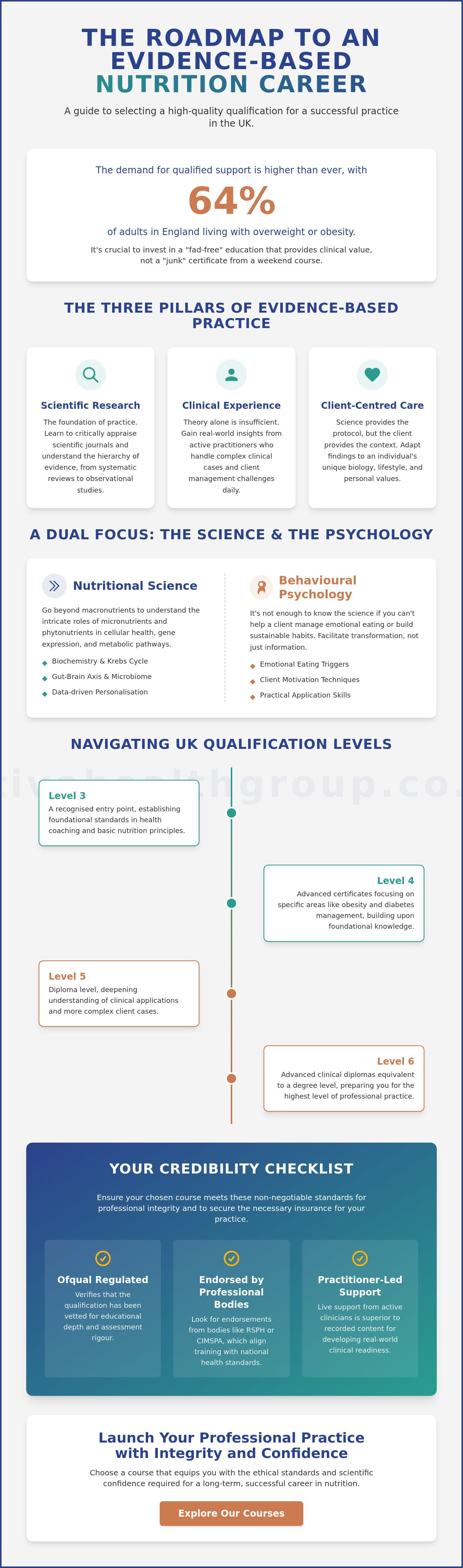
A weekend certificate no longer grants entry into the professional nutrition sector of 2026. With 64% of adults in England now living with overweight or obesity, the demand for qualified support is higher than ever, yet you've likely felt the frustration of sorting through conflicting dietary fads whilst wondering which path is legitimate. It's a common concern; the fear of investing in a "junk" certificate that lacks clinical value is real. To truly bridge the gap between theory and impact, you need an evidence-based nutrition coaching course that prioritises scientific rigour over superficial trends.
We understand that the legal distinction between a "coach" and a "nutritionist" often feels blurred, leaving many aspiring practitioners overwhelmed. This article clarifies the professional roadmap, moving you from foundational learning to advanced clinical practice. You'll discover how to select a programme that provides the professional accreditation and scientific confidence required to handle complex client cases. We'll examine the specific standards that define a high-quality qualification, ensuring you can launch your private practice with integrity and a clear sense of professional purpose.
Key Takeaways
Define how to identify a high-quality evidence-based nutrition coaching course by ensuring it integrates current research with clinical expertise and client-centred values.
Understand the necessity of a dual-focused curriculum that balances deep biochemical knowledge with the practical psychology of behavioural change.
Navigate the hierarchy of UK qualification levels to find the right starting point, from foundational Level 3 certificates to advanced Level 6 clinical diplomas.
Learn why live, practitioner-led support is superior to recorded content when preparing for the complexities of real-world clinical practice.
Establish a clear roadmap for launching a professional practice with the ethical standards and scientific confidence required for long-term career success.
Table of Contents
What Defines a Genuine Evidence-Based Nutrition Coaching Course?
In an era where social media algorithms often prioritise engagement over accuracy, the term "evidence-based" is frequently misused. A genuine evidence-based nutrition coaching course doesn't simply provide a list of "superfoods" or rigid meal plans. Instead, it equips you with a framework to integrate the best available research with clinical expertise and the unique values of your client. This rigorous approach is the only way to move from being a wellness enthusiast to becoming a respected professional in the health sector.
Adopting a "fad-free" education is essential for your professional integrity and for securing necessary insurance. Influencer-led advice often relies on anecdotal evidence or cherry-picked data that can't be replicated in a clinical setting. By contrast, enrolling in a comprehensive evidence-based nutrition coaching course provides you with the skills to critically appraise scientific journals, ensuring your recommendations are grounded in fact rather than fleeting trends.
The Three Pillars of Evidence-Based Practice
To practice safely and effectively, you must understand that evidence-based practice is a three-pronged approach. It moves beyond the textbook and into the complexities of human biology and behaviour.
Scientific Research: This is the foundation. You'll learn to navigate nutritional science by understanding the hierarchy of evidence, from systematic reviews and randomised controlled trials down to observational studies.
Clinical Experience: Theory alone is insufficient for professional practice. It's vital that your tutors are active practitioners who can share real-world insights into client management and the nuances of complex clinical cases.
Client-Centred Care: Science provides the protocol, but the client provides the context. You'll learn to adapt scientific findings to suit an individual's bio-individuality, lifestyle constraints, and personal values whilst maintaining professional boundaries.
Recognising Credible Accreditations in the UK
The UK health education landscape is specifically structured to protect the public and standardise the quality of training. When choosing a programme, you should look for qualifications that are regulated by Ofqual. This regulation ensures the course has been vetted for its educational depth and assessment rigour. Without this, you may find it difficult to obtain professional indemnity insurance, which is a non-negotiable requirement for anyone wishing to launch a private practice.
Endorsements from the Royal Society for Public Health (RSPH) or CIMSPA provide an additional layer of professional credibility. These bodies verify that your training aligns with national health standards. For those starting their journey, the Level 3 Health Coaching certificate serves as a recognised entry point, establishing the foundational standards required before moving into more advanced clinical nutrition study.
Core Pillars of Professional Nutrition Training: Science and Psychology
A high-quality evidence-based nutrition coaching course must bridge the gap between hard science and human behaviour. It's not enough to understand the Krebs cycle if you can't help a client manage their emotional eating during a stressful work week. Professional training requires a dual mastery of biochemistry and psychology. This integration ensures that practitioners don't just provide information but facilitate transformation. By linking theoretical concepts directly to their practical application, you gain the ability to support clients through the complexities of real-world health challenges.
Nutritional Science: Beyond Macronutrients
While many entry-level programmes focus heavily on calories and macronutrients, advanced training delves into the intricate roles of micronutrients and phytonutrients in cellular health. Understanding how these compounds influence gene expression and metabolic pathways is essential for clinical reasoning. Nutritional biochemistry serves as the foundation of clinical reasoning, allowing you to move beyond generic advice to personalised, data-driven strategies. This includes a deep understanding of the gut-brain axis and how the gut microbiome influences mental wellbeing and systemic inflammation. Even when referencing international standards like the Dietary Guidelines for Americans, a professional coach must be able to tailor these broad recommendations to the individual's specific metabolic profile. If you're looking to specialise in this area, our Level 5 Certificate in Gut Microbiome and Nutrition offers a focused pathway into this complex field.
Behavioural Change and Coaching Psychology
The most scientifically accurate dietary plan is useless if the client cannot follow it. This is where coaching psychology becomes indispensable. Rather than simply "telling" a client what to eat, you'll learn to use motivational interviewing techniques to uncover their true "favourite" outcomes and intrinsic drivers. This process identifies psychological barriers to adherence, such as deep-seated habits or environmental triggers, and replaces them with sustainable behaviours. The goal is to move the client from a state of dependency on the coach to a state of long-term autonomy. Mastery of these psychological tools is what separates an evidence-based nutrition coaching course from a simple dietary instruction manual.
Ethical practice is built upon a clear understanding of your "Scope of Practice". A nutrition coach is not a medical doctor or a registered dietitian, and staying within these professional boundaries is vital for legal and ethical safety. This involves knowing when to support a client's lifestyle and when to refer them to a specialist for cases requiring direct clinical treatment. To understand how a primary care physician like John Abroon M.D. provides the clinical diagnosis and personalised care that nutrition coaches often refer to, read more. By maintaining these standards, you protect both your clients and your professional reputation whilst ensuring your practice remains grounded in integrity.
Navigating UK Qualification Levels: From Foundations to Clinical Practice
Choosing the right evidence-based nutrition coaching course requires a clear understanding of the UK's educational hierarchy. The difference between a Level 3 and a Level 6 qualification isn't just about the volume of study; it defines the complexity of cases you're ethically and legally prepared to manage. Whilst many short courses offer "Continuing Professional Development" (CPD) points, these are designed to enhance the skills of existing professionals. They don't provide the comprehensive assessment or regulated framework required to launch a new career from scratch. A full professional qualification, by contrast, ensures you've met the rigorous standards set by Ofqual-regulated awarding bodies.
Level 3 vs Level 5: Building Professional Foundations
For those entering the field, the Level 3 Health Coaching certificate serves as the essential entry point. It provides the foundational knowledge required to support clients with basic nutritional improvements and lifestyle changes. This level is recognised as the minimum requirement for coaches working within NHS primary care settings. It focuses on the core principles of health and wellness, ensuring you can guide clients toward WHO guidelines on healthy diets with confidence.
Moving from Level 3 to Level 5 represents a significant shift in clinical depth. A Level 5 qualification, such as our Level 5 Certificate in Gut Microbiome and Nutrition, allows you to explore integrative health in much greater detail. At this stage, you move beyond basic advice and begin to understand the physiological interactions between diet, the microbiome, and systemic health. This level is ideal for practitioners who want to offer specialised support whilst maintaining a focus on health optimisation and disease prevention.
The Level 6 Clinical Distinction
The Level 6 Clinical Nutrition diploma is the gold standard for those seeking the highest level of professional recognition. Academically, this is equivalent to the final year of an undergraduate degree. It's designed for practitioners who wish to work with clients facing more complex health challenges, such as chronic fatigue, burnout, and metabolic dysfunction. You'll learn to synthesise complex data and apply advanced clinical reasoning to every case.
This pathway transforms you into a highly respected clinical nutrition practitioner. It provides the scientific depth needed to work alongside other healthcare professionals, ensuring you can navigate the nuances of chronic conditions with integrity. By completing a Level 6 evidence-based nutrition coaching course, you demonstrate a commitment to the highest professional standards, positioning yourself as an expert in a crowded and often poorly regulated market. Whether you're starting at the foundation or aiming for clinical mastery, your choice of level should align directly with your long-term career aspirations and the weight of responsibility you're prepared to carry. As you refine your clinical focus, you can check out ah! fertility nutrition to see how advanced practitioners apply nutritional therapy within specialised fields like reproductive health.
The Importance of Tutor Support and Clinical Readiness
Mastering the complexities of human health requires more than passive consumption of recorded content. Whilst digital platforms have made education more accessible, an evidence-based nutrition coaching course cannot be truly mastered through videos alone. Real clinical readiness is forged through interaction, debate, and the resolution of complex clinical questions that arise only when you begin to apply theory to real-world scenarios. This is why live, synchronous training is a cornerstone of professional standards in 2026, ensuring that you aren't just memorising facts but developing the critical thinking skills required for safe practice.
Engaging with a professional community and an active alumni network provides a safety net as you transition into your new career. These connections offer ongoing support and shared insights that are impossible to replicate in isolated self-study environments. By learning amongst a cohort of aspiring professionals, you gain diverse perspectives on client cases, which enriches your understanding and prepares you for the varied challenges of a private practice.
Mentor-Led Learning vs. Self-Study
The risk of "isolation" in 100% online, self-paced programmes is significant. Without direct access to a mentor, it's easy to misinterpret complex biochemical pathways or overlook the nuances of coaching psychology. Feedback on clinical case studies is vital for building practitioner confidence; it's the process of having your work reviewed by an experienced professional that sharpens your clinical reasoning. This mentor-led approach ensures you're not just following a curriculum but are being guided by someone who has navigated the same professional journey you're now embarking upon.
Preparing for Real-World Practice
The transition from "theory" to "practice" is often the most daunting phase for a new coach. Supervised clinical hours are essential to bridge this gap, allowing you to conduct sessions under the watchful eye of a tutor before you launch your own business. This phase focuses heavily on the practicalities of professional life, including ethics, insurance requirements, and maintaining strict professional boundaries. Understanding how to manage a client's expectations whilst staying within your scope of practice is what defines a truly prepared practitioner.
Part of this professional preparation includes understanding the wider healthcare ecosystem, where digital services and telehealth platforms like Aussie Scripts are becoming integral, demonstrating how technology can provide patients with convenient access to medical support alongside their lifestyle coaching.
If you're ready to take the first step on this professional roadmap, the Level 3 Health Coaching Foundation serves as the ideal entry point. This qualification establishes the standards needed to progress toward more advanced clinical study. For those aiming for the highest level of expertise, our Level 6 Diploma in Health Coaching and Clinical Nutrition provides the comprehensive support and clinical depth required to lead the industry.
Professional Pathways with Active Health Group
Active Health Group has spent 25 years establishing itself as a trusted guide in health education. As a not-for-profit educational body, we prioritise the weight of professional responsibility over commercial gains. This focus ensures that every evidence-based nutrition coaching course we provide is built on a foundation of integrity and real-world readiness. Our Level 6 Diploma in Health Coaching and Clinical Nutrition represents the pinnacle of this philosophy. It offers a rigorous pathway for those who wish to lead the profession with clinical depth and scientific authority.
Our practitioner-led approach is what truly sets our graduates apart. You aren't just learning from academics; you're being mentored by professionals who are active in the field. This ensures you're "clinic-ready" from the moment you qualify, possessing the practical skills and ethical grounding needed to manage complex client cases with confidence.
Why Our Not-for-Profit Status Matters to You
Choosing a training provider is a significant investment in your career. Because we operate as a not-for-profit, our resources are reinvested directly into your education. This translates into higher-quality tutor support, frequent curriculum updates to reflect the latest developments in health science, and a steadfast commitment to professional behaviour. We focus on your long-term success rather than shareholder dividends. This structural choice allows us to maintain the highest educational integrity, ensuring our graduates are prepared for the realities of modern clinical practice.
Your Professional Journey Starts Here
The path from student to practitioner is structured and supportive. When you enrol, you'll join a dedicated community of practitioners. In your first 90 days, you'll move from foundational theory to the initial stages of clinical reasoning, supported by a clear roadmap for your growth. We offer the flexibility of blended learning, which is ideal for busy UK professionals who need to balance their studies with existing work or family commitments. This approach makes an evidence-based nutrition coaching course accessible without sacrificing the rigour of live, synchronous clinical training.
We invite you to explore our Resources section to begin planning your professional roadmap in detail. Whether you're just starting or looking to advance to clinical mastery, we're here to support your journey. Join a community that values substance over superficiality and launch your private practice with the scientific confidence required to make a lasting impact.
Your Future in Clinical Nutrition Starts with Professional Rigour
Choosing a high-quality evidence-based nutrition coaching course is the first step toward a career defined by scientific integrity and ethical practice. You've seen how the integration of nutritional biochemistry and coaching psychology creates a framework for lasting client change, and why regulated qualifications are essential for professional insurance. Moving from foundational knowledge to advanced clinical reasoning requires a structured approach that prioritises depth over superficiality.
With 25 years of professional training excellence, Active Health Group remains a dedicated not-for-profit organisation focused on maintaining these high ethical standards. Every student receives practitioner-led tutor support, ensuring you're never left to navigate complex clinical case studies in isolation. We provide the mentorship and community you need to bridge the gap between theory and real-world application.
Explore our Level 6 Clinical Nutrition Diploma and start your professional journey today.
We're here to help you move from a state of learning to a state of confident professional practice. Your journey towards becoming a respected practitioner starts with a commitment to excellence, and we're ready to support you every step of the way.
Frequently Asked Questions
Is a nutrition coaching course enough to work as a nutritionist in the UK?
The title "Nutritionist" is not a legally protected term in the UK, meaning you can work in the field with a high-level coaching qualification. However, to practice safely and professionally, you need a regulated diploma that provides clinical depth. Whilst a degree is required to become a "Registered Nutritionist," a Level 6 diploma allows you to launch a private practice and support clients with complex health needs.
Can I get professional insurance with an online nutrition coaching certificate?
You can obtain professional indemnity insurance if your certificate is regulated by Ofqual and recognised by established professional bodies. Insurance providers require evidence that your training meets specific educational standards and includes rigorous assessments. Many "short" or unaccredited online courses fail to meet these criteria, leaving practitioners unable to secure the cover necessary for a legitimate private practice.
What is the difference between a Level 4 and a Level 6 nutrition course?
The primary difference lies in the academic depth and the complexity of cases you're prepared to handle. A Level 4 course focuses on foundational knowledge and basic dietary improvements for healthy populations. In contrast, a Level 6 qualification is equivalent to the final year of an undergraduate degree. It covers advanced nutritional biochemistry and clinical reasoning, allowing you to work with chronic metabolic conditions.
Do I need a science degree to enrol in an evidence-based nutrition coaching course?
A prior science degree is not a prerequisite for enrolment in most professional programmes. A high-quality evidence-based nutrition coaching course is designed to teach you the necessary biochemistry and health science from the ground up. You'll start with foundational concepts and progressively build toward advanced clinical applications, ensuring you develop scientific confidence regardless of your previous educational background.
How long does it take to qualify as a professional nutrition coach?
The timeline for qualification varies depending on the depth of the evidence-based nutrition coaching course you choose. A foundational Level 3 certificate can be completed in a few months, whilst a comprehensive Level 6 diploma typically requires 12 to 18 months of part-time study. This longer duration is essential to master the clinical skills and complete the supervised practice hours required for professional readiness.
Can a nutrition coach work with clients who have chronic health conditions?
Practitioners with advanced training, such as a Level 6 qualification, are equipped to support clients with chronic conditions like fatigue or metabolic dysfunction. However, you must always work alongside the client's medical team. The focus is on using nutrition and lifestyle interventions to support health optimisation, rather than attempting to "cure" or "treat" a medical diagnosis directly, which falls outside the coaching remit.
What is the "Scope of Practice" for a nutrition coach in the UK?
Scope of practice defines the professional boundaries within which a coach must operate to ensure client safety. It involves providing evidence-based guidance on diet and lifestyle whilst avoiding medical diagnosis or the prescription of medications. If a client presents with symptoms that suggest an underlying medical issue or an acute eating disorder, a coach's responsibility is to refer them to a GP or a registered dietitian.
Is Active Health Group accredited by professional bodies like CIMSPA or RSPH?
Active Health Group holds endorsements and accreditations from several leading organisations, including the Royal Society for Public Health (RSPH) and CIMSPA. Our RSPH Level 3 Certificate in Health Coaching ensures that our foundational training meets national standards. These accreditations provide graduates with the professional credibility needed to work in both private practice and integrated healthcare settings across the UK.


Has anyone else used a name generator for character names? I tried it while working on a fantasy character and found several combinations that fit the theme nicely.