.png)


Accredited Health Coaching Course UK: The 2026 Professional Pathway

Updated: Jun 17
In an unregulated industry, a simple certificate of completion is often just an expensive piece of paper that leaves you legally vulnerable and clinically unprepared. You've likely felt the mounting frustration of trying to decode the difference between Level 3, 5, and 6 qualifications, whilst worrying if your chosen accredited health coaching course UK will actually permit you to work with complex client cases. It's a valid concern because the transition from enthusiast to professional requires far more than just passion; it demands a rigorous, evidence-based framework that stands up to professional scrutiny.
The transition from learning to practice is where many new coaches feel most vulnerable. Our Level 5 and Level 6 qualifications are designed to mitigate this uncertainty by including specific modules on business launch and professional boundaries. We provide the legal and operational frameworks you need to set up your practice, from drafting client contracts to understanding insurance requirements. AHG graduates don't just hold a certificate; they run successful private practices and collaborate within clinical settings across the UK and beyond. You'll join a global alumni network of wellness business owners who share a commitment to evidence-based care and person-centred service. For those interested in how high-level professional communities operate in adjacent sectors like premium travel, you can learn more about Learning Centre Access through the Africa Luxury Hospitality Network (ALHN).
This article will help you identify a high-standard qualification that bridges the gap between theoretical knowledge and clinical practice, ensuring you meet the UKIHCA’s 2026 supervision requirements. You'll discover how to gain the confidence needed to master clinical nutrition and behaviour change psychology without overstepping your legal scope of practice. We will outline the specific professional pathways available to you, providing a clear roadmap from initial training to successful self-employment in the evolving health sector.
Key Takeaways
Understand how Ofqual-regulated frameworks and external bodies ensure your qualification represents a rigorous professional standard rather than a mere certificate of completion.
Learn the critical distinctions between Level 3, 5, and 6 to choose an accredited health coaching course UK that aligns with your specific career ambitions.
Identify the specific approval criteria set by the UKIHCA and PCI to ensure your training meets the 2026 requirements for professional registration and supervision.
Evaluate potential training providers based on the depth of their clinical curriculum and the availability of direct, practitioner-led tutor support.
Gain a clear roadmap for transitioning from foundational studies to advanced clinical nutrition and behaviour change psychology for professional self-employment.
Table of Contents
What defines an accredited health coaching course in the UK?
In the UK's evolving wellness sector, accreditation represents a rigorous external review process rather than a simple internal stamp of approval. An accredited health coaching course UK is a training programme that has been audited by an independent awarding body to ensure it meets specific educational standards. This process moves the curriculum beyond a series of videos or lectures; it transforms it into a regulated pathway that prepares you for the complexities of client work. By aligning with the Regulated Qualifications Framework (RQF), these courses provide a benchmark of quality that is recognised by employers and professional bodies alike.
It's vital to understand that "recognised" and "accredited" are not interchangeable terms. In the wellness industry, many providers claim their courses are recognised by various organisations, but this often lacks the weight of a formal audit. Accreditation involves a deep dive into the assessment methods, tutor qualifications, and the accuracy of the scientific content. This health coaching overview highlights how these structured methods are essential for integrating coaching into broader health systems. Without this external verification, a qualification may fail to provide the professional indemnity insurance eligibility you need to practice safely.
The difference between certification and accreditation
The distinction between these two terms is often the difference between a hobbyist and a professional. Anyone can issue a certificate of attendance, but accreditation requires an external audit. Accredited courses must map their curriculum to specific professional competencies, ensuring that every student graduates with a verified level of skill. Choosing an unaccredited course carries significant risks. You might find yourself legally vulnerable if a client suffers an adverse outcome, as many insurance providers refuse to cover practitioners who lack a regulated qualification. It's a matter of professional liability and, more importantly, client safety.
Why professional standards are rising in 2026
The UK health landscape has undergone a significant shift toward personalised care. As the NHS integrates more health and wellbeing coaches into primary care networks, the demand for high-standard training has never been higher. The UK Health Coaches Association (UKIHCA) now sets the gold standard for the industry, requiring coaches to demonstrate a clear understanding of clinical boundaries and ethical practice. By 2026, the expectation for practitioners to engage in regular supervision and evidence-based practice has become the norm. This professionalisation ensures that coaches don't just offer advice but facilitate sustainable behaviour change within a safe, professional framework.
Understanding the UK qualification levels: 3, 5, and 6
Selecting an accredited health coaching course UK requires a clear understanding of the Regulated Qualifications Framework (RQF). These levels aren't merely arbitrary numbers; they define the depth of your scientific knowledge, the complexity of the clients you can safely support, and your eventual professional standing. Moving from a foundational understanding to clinical mastery involves a structured progression that ensures you're prepared for the weight of practitioner responsibility. Choosing the right tier depends on whether you seek a role within an established organisation or aim to build an independent clinical practice.
Level 3 Foundations: The starting point
Level 3 serves as the entry-level gateway into the profession. These programmes focus on the core principles of behaviour change and provide a basic introduction to nutrition and lifestyle medicine. This level is particularly suited to career changers who wish to explore the field without committing to years of advanced study. It also aligns with the NHS professional standards for health coaches, which set Level 3 as the minimum requirement for those working in primary care settings. However, whilst excellent for health promotion roles, Level 3 may not provide the clinical depth required to manage complex private clients or chronic health conditions effectively.
Level 5 Professional Practice: The industry standard
For those intending to launch a self-employed business, Level 5 is often considered the professional sweet spot. This level of training delves deeper into coaching psychology, advanced physiology, and the practicalities of business setup. It moves beyond basic advice into the integration of complex topics like the gut microbiome and metabolic health. Graduates at this level possess the technical proficiency to work independently, bridging the gap between general wellness and clinical application. If you're ready to transition into a full-time career, exploring a Level 5 Professional Practice programme offers the necessary rigor to build a sustainable and ethical business.
Level 6 Clinical Training: For the expert practitioner
Level 6 represents the pinnacle of non-degree professional training, moving the practitioner into the realm of clinical specialism. At this stage, the focus shifts to addressing complex cases such as chronic fatigue, burnout, and intricate nutritional needs. This training allows for a seamless collaboration with medical professionals, as the coach understands the language of clinical nutrition and pathology. It's a transition from being a "coach" to becoming a "clinical health practitioner." This advanced pathway is designed for those who wish to work at the highest level of the industry, providing evidence-based interventions for clients with multi-faceted health challenges.
Key accreditation bodies and professional standards
Whilst understanding qualification levels is vital, the authority of your certificate depends entirely on the bodies that endorse it. In the United Kingdom, several organisations maintain the ethical and educational scaffolding of the industry. Selecting an accredited health coaching course UK means choosing a programme that has met the specific, rigorous criteria of these institutions. These bodies serve as gatekeepers, ensuring that practitioners possess not just the knowledge, but the clinical safety and professional boundaries required to protect the public. Without this oversight, the distinction between a professional coach and a wellness enthusiast becomes dangerously blurred.
UKIHCA: The voice of the profession
The UK Health Coaches Association (UKIHCA) is the primary professional body for the industry. For a course to be fully approved, it must include a minimum of 60 hours of live, synchronous training. This requirement ensures that students don't just consume pre-recorded content but engage in real-time coaching practice and receive direct feedback. Gaining UKIHCA approval is a non-negotiable for many private sector roles; it signals to potential clients that you've been trained to an industry-standard level of competency. Being listed on their professional register provides an added layer of credibility, helping you stand out in an increasingly crowded wellness market whilst ensuring you adhere to a strict code of ethics.
PCI and the NHS pathway
The integration of health coaching into the NHS represents a significant shift in the UK's healthcare strategy. Health and Wellbeing Coaches are now a staple within Primary Care Networks (PCNs), working alongside GPs to manage long-term conditions through lifestyle medicine. To work within this system, your training must align with the competencies set by the Personalised Care Institute (PCI). You can verify suitable programmes through the Personalised Care Institute accredited training list. This alignment ensures that practitioners understand the nuances of the NHS framework, from patient confidentiality to the specific ethics of clinical collaboration. Active Health Group ensures all pathways are mapped to these national standards, preparing you for both public and private sector success.
The Royal Society for Public Health (RSPH) also plays a crucial role, often acting as a secondary mark of educational quality. Their endorsement suggests a curriculum that is grounded in broader public health goals and evidence-based practice. By following these established standards, training providers ensure their graduates are not just coaches in name, but respected members of the wider healthcare workforce. This structured approach protects both the practitioner and the client, maintaining the integrity of health coaching as a serious, evidence-based discipline that delivers measurable health outcomes.
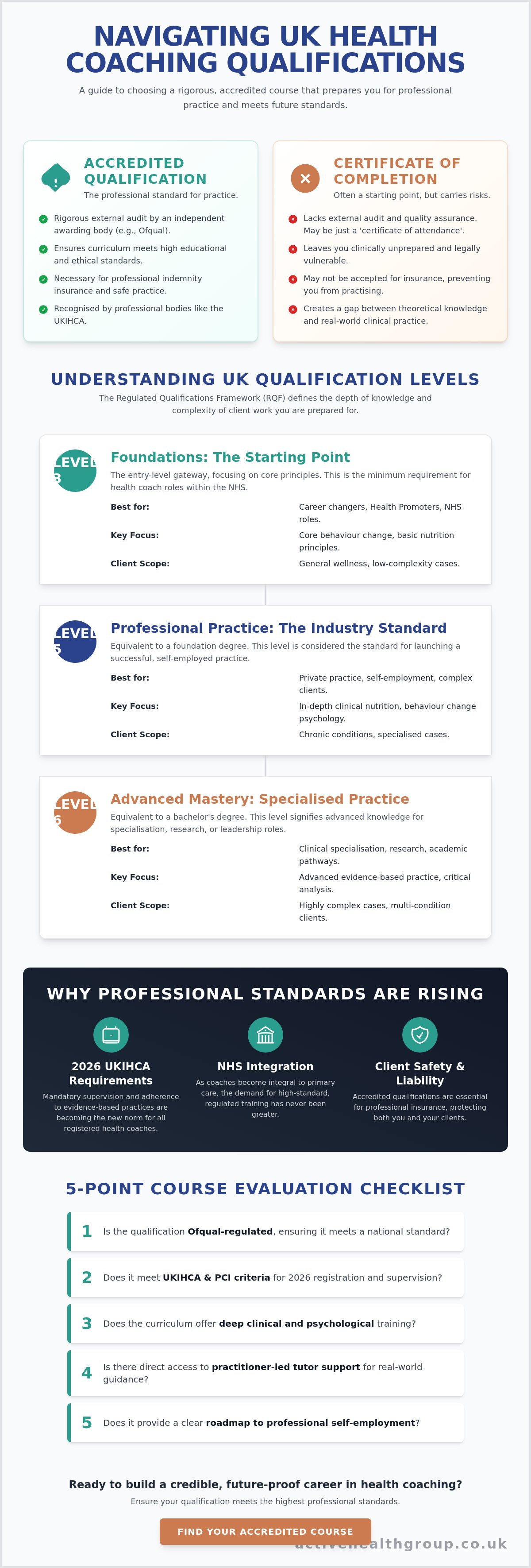
How to evaluate a health coaching course: 5 essential criteria
Selecting a training provider is a decision that defines your future professional integrity. It's easy to be swayed by slick marketing, but you must look beneath the surface. An accredited health coaching course UK should be evaluated on its ability to produce safe, effective, and business-ready practitioners. A high-quality programme doesn't just hand over a certificate; it builds a foundation of clinical competence. You're entering a field where your clients' health is at stake, so the rigor of your education is paramount.
Curriculum Depth: Ensure the syllabus balances physiological science with coaching psychology. You need to understand both the "what" of health and the "how" of change.
Tutor Support: Check if there is a qualified mentor to review your practice. Real-time feedback is essential for developing relational skills.
Clinical Application: Verify if there are opportunities for supervised client work or clinical case study reviews. Theory without practice is a professional risk.
Business Education: Look for modules that teach you how to structure fees, obtain insurance, and draft legal contracts. Professionalism extends to your business operations.
Institutional Stability: Investigate the provider’s history. A stable, experienced organisation is more likely to offer long-term support and industry-recognised credentials.
Tutor support vs. automated learning
Coaching is a relational skill. You cannot learn empathy or active listening from a static video. Many budget courses rely on automated learning where students click through slides with zero human interaction. This approach is insufficient for a clinical role. At Active Health Group, we utilise the AHG Online Academy to provide flexibility, but we anchor this with direct tutor interaction to ensure your skills are sharp and ethically sound. Feedback from a practitioner-led mentor is what separates a student from a professional. It's the difference between knowing the theory and being able to hold space for a client's struggle.
Clinical nutrition and behaviour change integration
A professional coach must understand nutrition beyond basic government guidelines. You need to grasp how metabolic health and the gut microbiome influence client outcomes. Equally, scientific knowledge is useless if you cannot facilitate change. Look for courses that integrate evidence-based models like Motivational Interviewing. This ensures you aren't just giving advice, but are actually helping clients dismantle deeply ingrained habits. A truly integrative approach bridges the gap between biological theory and psychological practice. It allows you to offer solutions that are both scientifically valid and practically achievable for the individual.
Ready to begin your journey? Explore our accredited health coaching pathways to find the right level for your professional goals.
Launching your career with Active Health Group
Active Health Group has spent 25 years establishing a practitioner-led model of education that prioritises clinical integrity over commercial growth. Choosing an accredited health coaching course UK with us means joining a community that has trained over 10,000 students since the year 2000. Our "Foundation to Clinical" pathway provides a structured journey that bridges the gap between basic health promotion and advanced clinical practice. We don't just teach theory; we prepare you to see clients with confidence from the moment you graduate. With a 95% course completion rate, our methodology is proven to support adult learners as they transition into new, meaningful careers.
The AHG not-for-profit mission
Being a not-for-profit training provider allows us to reinvest every resource back into the quality of your education. We aren't beholden to shareholder returns, which means we can focus entirely on maintaining the highest ethical standards and the integrity of the health coaching profession. This structure ensures that our fees represent exceptional value whilst providing access to high-level clinical training that is often only found in academic settings. We believe that professional recognition should be accessible to those with the dedication to earn it; our mission is to provide the stable, reliable mentorship needed to reach that goal.
From student to practitioner: The first 12 months
The transition from learning to practice is where many new coaches feel most vulnerable. Our Level 5 and Level 6 qualifications are designed to mitigate this uncertainty by including specific modules on business launch and professional boundaries. We provide the legal and operational frameworks you need to set up your practice, from drafting client contracts to understanding insurance requirements. AHG graduates don't just hold a certificate; they run successful private practices and collaborate within clinical settings across the UK and beyond. You'll join a global alumni network of wellness business owners who share a commitment to evidence-based care and person-centred service.
If you're ready to move beyond the basics and build a career grounded in clinical rigor, explore our Level 5 Professional Practice course to begin your professional journey.
Your professional pathway to clinical excellence
Choosing an accredited health coaching course UK is the most critical decision you'll make for your career's longevity and legal safety. You now understand that whilst Level 3 provides an entry point, moving toward Level 5 or 6 is essential for those seeking independent clinical practice and deeper expertise in nutrition. By prioritising qualifications aligned with the UKIHCA and PCI, you ensure your practice meets the rigorous standards expected by both the private sector and the NHS.
Active Health Group has spent 25 years championing not-for-profit integrity and practitioner-led training. We provide the structured mentorship required to move you from a state of learning to a state of professional practice. Your journey toward becoming a respected health practitioner starts with an education that values evidence over trends and clinical safety over commercial speed.
Ready to map out your next steps? Download our Professional Health Coaching Career Guide and discover how to build a practice that delivers lasting impact. We look forward to supporting your transition into this rewarding professional field.
Frequently Asked Questions
Is health coaching a regulated profession in the UK?
Health coaching is not currently a government-regulated profession in the UK, which means there are no legal requirements to practice. Instead, the industry relies on self-regulation through professional bodies such as the UK Health Coaches Association (UKIHCA). These organisations establish codes of conduct and professional boundaries to ensure practitioner safety and public protection.
Can I become a health coach without a university degree?
You don't need an undergraduate degree to become a professional health coach. Vocational qualifications at Level 3, 5, or 6 provide a comprehensive alternative that focuses on the practical application of coaching psychology and nutrition. These accredited health coaching course UK pathways are specifically designed for adult learners who value a direct route into professional practice.
What is the difference between a nutritionist and a health coach?
The primary difference lies in the focus of the intervention. Nutritionists are specialists in the science of food and its effect on the body, whereas health coaches act as catalysts for sustainable behaviour change. Whilst a health coach may have deep nutritional knowledge, their role is to help clients implement lifestyle changes through psychological support and habit formation.
How much does an accredited health coaching course cost in the UK?
Course fees for health coaching vary significantly depending on the qualification level and the depth of the curriculum. Foundations at Level 3 are generally the most accessible, whilst advanced Level 6 clinical diplomas require a larger investment due to their technical complexity. You should check each provider's specific fee structure and payment options to find a programme that matches your career ambitions.
Can I study for a health coaching qualification whilst working full-time?
Most accredited health coaching qualifications are designed to be completed whilst working full-time. Online academies and modular learning structures allow students to progress through the curriculum at their own pace. This flexibility ensures that you can balance your professional responsibilities whilst moving from a state of learning to a state of clinical practice.
What can a health coach legally advise on in the UK?
Health coaches provide support with lifestyle factors such as nutrition, sleep, and stress management, but they cannot legally diagnose or treat medical conditions. Their scope of practice is limited to supporting clients in achieving their wellness goals and following protocols set by medical professionals. Maintaining these professional boundaries is essential for ensuring client safety and practitioner insurance eligibility.
How long does it take to qualify as a professional health coach?
The timeline to qualify as a health coach depends on the depth of the accredited health coaching course UK you select. An entry-level Level 3 certificate may take a few months, whereas a professional Level 5 or 6 diploma typically requires 12 to 18 months of study. This longer duration reflects the clinical rigor and supervised practice hours needed for professional mastery.
Are online health coaching courses recognised by insurance companies?
Online courses are recognised by major UK insurance companies as long as they are accredited by a regulated awarding body. Insurers look for qualifications that meet the National Occupational Standards and include a minimum number of guided learning hours. Always verify that your chosen course leads to a recognised RQF qualification to ensure you can obtain professional indemnity cover.


Has anyone else used a name generator for character names? I tried it while working on a fantasy character and found several combinations that fit the theme nicely.