.png)


Health Coach Salary UK: What Can You Really Earn in 2026?

Updated: Jun 5
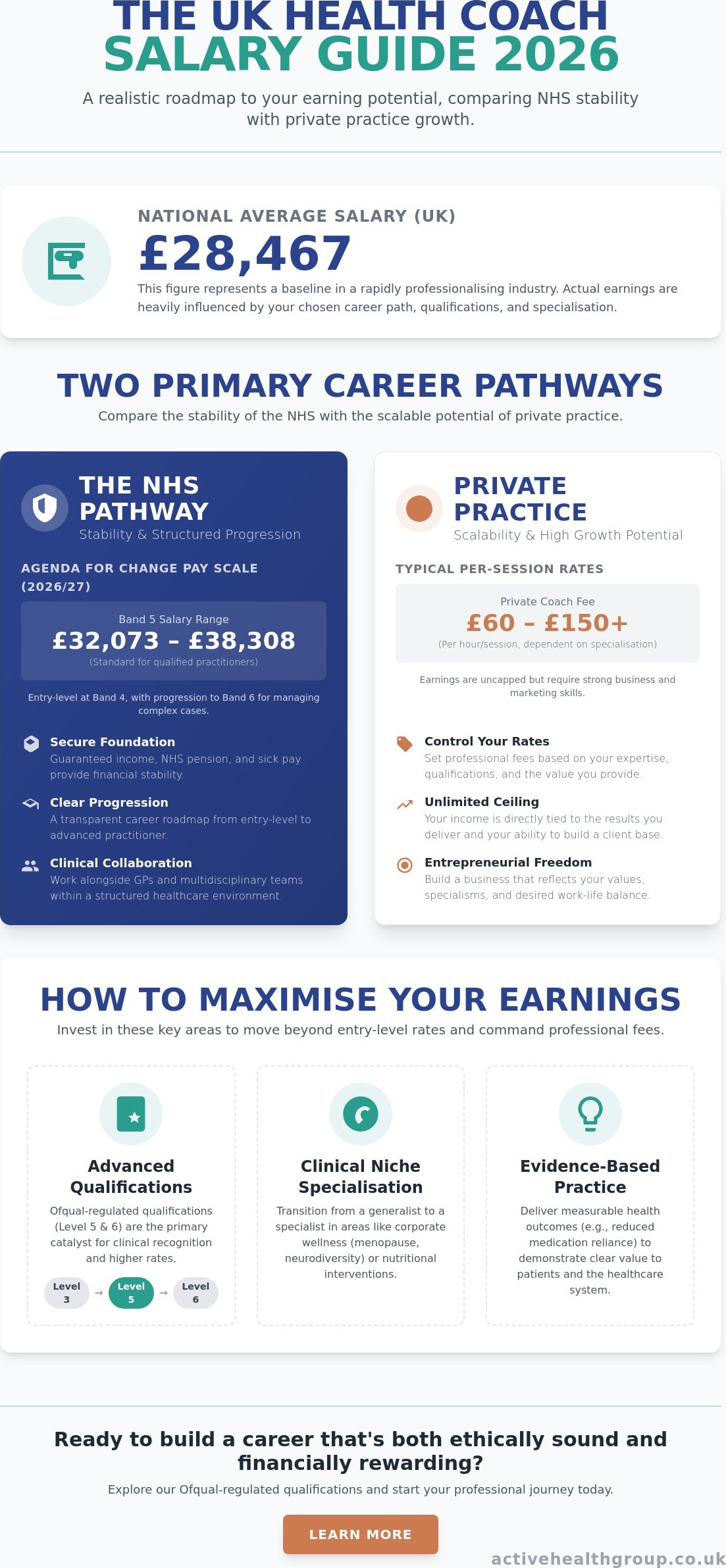
While the national average health coach salary UK practitioners earn is £28,467, those working within the NHS can now earn up to £38,308 on the Band 5 pay scale. It's understandable if you feel hesitant about the return on investment for your training, especially when the wellness industry often appears unregulated or financially unpredictable. You're likely looking for more than just a passion project; you're seeking a professional career with a clear, scalable income path that reflects your level of expertise.
This guide provides a realistic roadmap for your earnings in 2026, moving from the stability of public sector bands to the high-growth potential of private practice. We'll explore how specific Ofqual-regulated qualifications, particularly at Level 5 and 6, act as the catalyst for increasing your rates and securing clinical recognition. You'll gain a practical framework for setting private fees and a clear understanding of how to build a career that's both ethically sound and financially rewarding.
Key Takeaways
Determine the realistic health coach salary UK practitioners can expect by comparing the structured stability of the NHS with the scalable potential of private practice.
Navigate the NHS Agenda for Change pay scales to understand how Band 5 roles provide a secure financial foundation for those entering the public healthcare sector.
Identify how professional accreditation and clinical niche specialisation allow you to move beyond entry-level rates and command higher professional fees.
Follow a clear professional roadmap from Level 3 foundations to Level 5 Professional Practice to ensure you are equipped for complex client requirements.
Build a sustainable business model by integrating ethical standards, clinical boundaries, and practitioner-led support into your daily coaching practice.
Table of Contents
The UK Health Coach Salary Landscape in 2026
As of May 2026, the average health coach salary UK professionals receive stands at £28,467 per year. This figure, however, represents a broad baseline in a rapidly professionalising industry. The UK healthcare landscape has undergone a fundamental shift, moving away from treating health coaching as a peripheral wellness hobby and towards its integration as a core component of the NHS personalised care model. This transition is driven by an urgent need to reduce the burden on GPs, who increasingly rely on coaches to support patients with lifestyle-related chronic conditions.
There's now a clear distinction between "wellbeing assistants" and "accredited health coaches." While assistants often perform general support tasks, accredited practitioners use evidence-based psychological frameworks to facilitate lasting behavioural change. This professionalisation has created a more structured career path where your level of training directly dictates your value in the modern market.
Defining the Health Coach Role in the Modern Market
To understand why earning potential is rising, we must first ask: What is a Health Coach? In the current climate, the role is defined by clinical rigor and professional boundaries. It's no longer enough to offer general advice; practitioners must demonstrate expertise in coaching psychology and health sciences. This evolution has opened doors across three primary sectors:
Healthcare: Working within Primary Care Networks (PCNs) or integrated care boards to manage patient caseloads.
Corporate Wellness: Leading initiatives in large organisations that focus on specific areas like menopause support or neurodiversity.
Private Clinics: Collaborating with multidisciplinary teams to provide specialised nutritional and lifestyle interventions.
Why Salary Figures Vary So Widely
The health coach salary UK market is characterised by significant variance. Whilst geographical demand influences pay, the primary driver for higher earnings is the shift from generalist to specialist. Salaried employment in the public sector provides stability, a structured pension, and clear progression. In contrast, private sector roles often offer higher per-session rates but require a more robust business mindset to maintain consistency.
Practitioners who invest in higher-level qualifications, such as a Level 5 or Level 6 diploma, often find they can command professional fees that far exceed the national average. This is because they aren't just providing a service; they are delivering measurable health outcomes. When a coach can reduce a patient's reliance on medication or improve their metabolic health markers, their value to both the patient and the healthcare system increases exponentially. This clinical rigor is what separates the top earners from those just starting their professional journey.
NHS vs. Private Sector: Comparing Career Pathways
The decision to enter the public sector or launch a private practice is often the most significant choice a practitioner will make. Each path offers a different financial trajectory and a distinct set of professional responsibilities. While the average health coach salary UK data provides a general benchmark, your actual earnings will depend on how you navigate these two very different landscapes. One path offers a secure floor of guaranteed income and benefits, whereas the other provides a much higher ceiling for those with a business-minded approach.
Working within the NHS: Bands 4 to 6
Employment within the NHS is governed by the Agenda for Change pay scales, providing a transparent structure for career progression. Entry-level Health and Wellbeing Coaches typically start at Band 4, focusing on lifestyle support and social prescribing. However, the standard for fully qualified practitioners is Band 5. For the 2026/27 period, the Band 5 salary range is £32,073 to £38,308.
Moving from Band 5 to Band 6 usually requires advanced clinical training and the ability to manage more complex patient cases within Primary Care Networks (PCNs). The benefits of this route are substantial. You gain access to the NHS pension scheme, sick pay, and a structured environment where you work alongside GPs and multidisciplinary teams. It's a path defined by stability and a clear professional roadmap from learning to practice.
The Private Practice Route: Setting Your Rates
The private sector operates without the constraints of fixed pay scales, which significantly alters the expected health coach salary UK professionals can achieve. In 2026, private health coaches in the UK typically charge between £60 and £150 per hour for one-on-one sessions. This variation often reflects the coach's experience level and their specific UK Coaching Salary Expectations based on clinical outcomes and expertise.
To maximise revenue, successful private practitioners often move away from hourly billing in favour of a "Package Model." For example, a six-week structured programme can provide more predictable income than ad-hoc sessions. Specialising in high-demand areas, such as gut health or metabolic wellness, allows you to command premium rates because you are solving specific, complex problems. Many practitioners now opt for a "Hybrid Model." This involves working part-time in a secure NHS Band 5 role whilst building a specialised private practice on the remaining days. This approach balances the security of a guaranteed salary with the high-growth potential of self-employment. To prepare for this transition, many students begin with a Level 5 Professional Practice qualification to ensure they meet the rigorous standards required by both sectors.
Key Factors Influencing Your Earning Potential
While the national average health coach salary UK practitioners see is a helpful guide, your personal earning ceiling is dictated by specific professional levers. It's common for those entering the field to assume that passion alone will drive revenue; however, the market prioritises evidence and ethics. Moving from a baseline income to a premium professional rate requires a strategic focus on accreditation, clinical depth, and a disciplined approach to your scope of practice.
The Importance of Accredited Training
Employers and private clients alike look for tangible proof of competence. Securing a Level 3 Health Coaching Foundation is the essential starting point for any practitioner aiming for professional recognition. Without Ofqual-regulated credentials, you'll likely struggle to secure professional indemnity insurance, which is a non-negotiable requirement for private practice. Accreditation doesn't just provide a certificate; it establishes the professional boundaries that protect both you and your clients. In a market that values safety and standards, being "unaccredited" often means being unhired.
Specialisation as a Revenue Driver
Generalism often leads to price competition. In contrast, specialisation allows you to position yourself as an expert in high-demand areas such as the gut microbiome, metabolic health, or burnout recovery. Clients facing complex health challenges are rarely looking for a generalist; they seek practitioners who understand the specific clinical nutrition and psychological factors behind their symptoms. By focusing on a niche, you can move away from hourly rates and towards high-value intervention packages. This expertise is what justifies a higher health coach salary UK clients are willing to pay for specialised outcomes rather than general advice.
Scope of Practice as a Financial Safeguard
Maintaining a clear scope of practice is perhaps the most overlooked financial safeguard in the coaching industry. It's sometimes tempting to stray into diagnostic or therapeutic territory to help a client, but doing so creates significant legal and financial risk. Staying within your professional lane ensures you remain insurable and maintains the integrity of your practice. By documenting successful case studies within your defined scope, you build a reputation for reliability. This reputation, grounded in ethical conduct and proven results, becomes your most valuable asset when negotiating contracts or setting premium private fees. Professionalism, in this sense, is not just about what you do, but also about knowing exactly what you don't do.
Maximising Your Income through Advanced Qualifications
The trajectory of a health coach salary UK professional is rarely linear. It follows a structured ladder of competency. Moving from a foundational role to a clinical specialist requires more than experience; it demands a commitment to higher-level Ofqual-regulated training. By following a clear educational roadmap, you can transition from entry-level support to high-value consultancy roles that command premium fees.
The progression starts with securing an accredited Level 3 foundation to enter the workforce. From there, you can progress to Level 5 Professional Practice, which equips you to handle complex client cases that generalists cannot manage. Achieving Level 6 Clinical status allows you to work alongside medical professionals with clients facing chronic conditions. By integrating nutrition and coaching psychology, you create a multi-service offering that increases your value per client. Finally, experienced practitioners often transition into clinical supervision or corporate consultancy, where earning potential reaches its peak.
From Level 3 to Level 6: The Salary Ladder
Your earning potential is intrinsically linked to the complexity of the problems you can solve. A Level 3 practitioner typically works in supportive, community-based roles or entry-level NHS positions. However, moving to Level 6 Clinical Training changes your professional standing entirely. At this level, you possess the rigour necessary to integrate with medical teams, providing the lifestyle interventions that complement clinical care. Data suggests that higher levels of education correlate with improved client retention rates. Clients stay longer and pay more when they feel they're in the hands of a highly qualified specialist. This depth of knowledge transforms you from a wellness guide into a critical healthcare partner.
The Role of Continuous Professional Development (CPD)
Professional growth doesn't end with a diploma. Staying current with emerging sciences, such as the gut microbiome or metabolic health, adds layers of value to your practice. This concept of "Practitioner Readiness" ensures you can work with clients immediately upon graduation, applying the latest evidence-based protocols to real-world scenarios. Active Health Group has a 25-year history of producing high-earning graduates who lead the industry in clinical excellence. If you're ready to advance your career, exploring a Level 6 Diploma in Health Coaching and Clinical Nutrition is the logical next step in your professional journey.
Building a Sustainable and Profitable Coaching Practice
Transitioning from a student to a professional practitioner requires a shift in focus from purely clinical knowledge to a robust business mindset. Whilst your expertise in coaching psychology is the foundation of your service, your ability to manage clients, marketing, and ethical boundaries determines the long-term stability of your health coach salary UK earnings. Success in the private sector isn't merely about finding clients; it's about creating a system that retains them through evidence-based results and professional integrity.
One of the most significant advantages during this transition is access to practitioner-led tutor support. Having a mentor who has already navigated the complexities of the UK market ensures you don't have to guess when it comes to setting up your practice. Similarly, leveraging an alumni network provides a pathway to high-paying opportunities and collaborative referrals that are often invisible to those working in isolation. By positioning yourself as an authority through rigorous, evidence-based practice, you move away from the wellness noise and into the space of professional healthcare consultancy.
Launch Your Practice within 12 Months
A realistic timeline for most dedicated students involves moving from enrolment to seeing paid clients within a single year. This progression is made possible through practical assessments at Active Health Group that mirror real-world billing and client management scenarios. Much like how YTA Training provides intensive routes for those looking to learn a trade in their 30s, these focused diplomas are designed for rapid, professional career transitions. You'll need to decide between the low overheads of a digital-first practice and the prestige of a physical clinical space. Many practitioners begin online to minimise initial costs, allowing them to reinvest their early revenue into further specialised training. This lean approach ensures that your practice becomes profitable quickly, providing a secure financial base whilst you build your reputation amongst local healthcare providers.
Ethical Standards as a Business Asset
In an industry that is voluntarily regulated, high ethical standards serve as your most powerful marketing tool. Clients are increasingly discerning; they value practitioners who understand professional boundaries and prioritise person-centred care over high-pressure sales. This commitment to ethics leads to a natural referral loop from satisfied clients and medical professionals alike, ensuring long-term stability. Training with a not-for-profit organisation further enhances your credibility, as it signals a commitment to educational integrity rather than commercial gain. Ready to start your journey? Explore our Foundations in Health Coaching (Level 3) to begin building your professional future today.
Securing Your Future in Professional Health Coaching
The path to a rewarding health coach salary UK practitioners can rely on is built upon a foundation of clinical rigor and ethical practice. You've seen how the landscape diverges between the structured security of NHS pay bands and the uncapped potential of a specialised private practice. By moving beyond foundational knowledge and embracing advanced Level 5 and Level 6 qualifications, you position yourself as a vital partner in the modern healthcare system. This journey is not just about earning a certificate; it's about developing the evidence-based skills that solve complex client problems and justify professional fees.
Start your professional health coaching journey with Active Health Group. As a not-for-profit organisation with 25 years of practitioner-led experience, we focus on your long-term success through accredited Level 3, 5, and 6 pathways. Your transition from learning to professional practice is a profound commitment to service and excellence. We're here to guide you at every stage of your career.
Frequently Asked Questions
What is the starting salary for a health coach in the UK?
An early career health coach with one to four years of experience typically earns an average of £20,993 per year. This figure often increases as you move into the public sector, where entry-level NHS Band 4 roles provide a structured starting point. Gaining clinical experience is the primary driver for moving beyond this initial baseline towards the national average.
Do I need a university degree to earn a good salary as a health coach?
You don't need an undergraduate degree to achieve a high health coach salary UK practitioners can sustain a career on. The industry recognises Ofqual-regulated Level 5 and Level 6 diplomas as the professional benchmark for clinical practice. These qualifications provide the specific coaching psychology and nutritional science training that employers and private clients prioritise over a general degree.
Can I work as a health coach in the NHS?
Yes, the NHS is a major employer of health and wellbeing coaches through Primary Care Networks. Most of these roles are salaried at Band 5 of the Agenda for Change pay scale, which ranges from £32,073 to £38,308 for the 2026/27 period. These positions offer excellent stability, a structured pension, and a clear path for professional progression into higher bands.
How much can I charge per hour in private health coaching?
Private health coaches in the UK typically charge between £60 and £150 per hour for individual sessions. Your specific rate depends on your level of accreditation and your niche expertise. Many practitioners maximise their income by moving away from hourly billing and instead offering structured programme packages that provide more predictable monthly revenue.
Is health coaching a regulated profession in the UK?
Health coaching is currently a voluntarily regulated profession. Whilst there are no government-mandated licenses, professional standards are maintained through accreditation from bodies like the UK & International Health Coaches Association. Securing a recognised qualification is essential for obtaining professional indemnity insurance and demonstrating your commitment to ethical, evidence-based practice.
How does a Level 5 qualification impact my earning potential?
A Level 5 qualification acts as a catalyst for higher earnings by qualifying you for more complex roles. It's often the minimum requirement for NHS Band 5 positions and provides the clinical depth needed to justify premium private rates. This level of training ensures you can safely manage clients with chronic conditions, which significantly broadens your potential client base.
What are the highest-paying niches in UK health coaching?
Specialised niches such as metabolic health, gut microbiome support, and corporate menopause wellness are currently the highest-paying areas. Clients facing these specific challenges often seek out experts rather than generalists and are willing to pay higher fees for targeted clinical outcomes. Focusing on these high-demand fields allows you to command professional rates that exceed the national average.
Can I make a full-time living from health coaching alone?
It's entirely possible to make a full-time living by following a structured professional roadmap. Many practitioners achieve this by combining a part-time salaried role with a growing private practice. As your reputation and case studies build, you can transition into full-time self-employment or move into senior consultancy and clinical supervision roles within the healthcare sector.


Honestly, looking into what a health coach salary UK professionals can pull in for 2026 is super interesting, especially since the numbers fluctuate so much depending on whether you are stuck working standard NHS bands or branching out independently with your own private packages. It is wild to see how much more flexibility you get once you stop relying solely on baseline hourly rates and start building actual group programs or corporate wellness gigs, kinda like how beauty entrepreneurs diversify their high-end aesthetic services when they branch out into specialized treatments like Botox Korea to boost their overall brand appeal and revenue streams. At the end of the day, breaking past that standard national average really comes down to niche…
This breakdown of what health coaches can really make in the UK right now is super eye-opening. It is wild to see how much the numbers vary depending on whether someone is working an NHS role, doing private practice, or burning out trying to build a client base from scratch. Honestly, when you are dealing with your own exhausted perimenopause symptoms day in and day out, even thinking about launching a business or climbing an NHS pay band feels like climbing Everest. But it is really reassuring to see what realistic earning potentials look like once people carve out a proper niche, especially supporting women navigating midlife changes. Thanks for keeping it so honest about the actual financial side of…
Canuckle has become one of those quick games I check during a coffee break. Trying to use the revealed letters efficiently is probably my favorite part.
This is a valuable point about building a sustainable career in health coaching. I especially like the emphasis on accreditation, evidence-based practice, and staying within a clearly defined scope of practice. Professional credibility can make a significant difference when attracting clients and establishing trust. The same principle applies when recommending complementary healthcare services, where qualifications and ethical standards are equally important, such as choosing a reliable Oakville Dentist. Overall, the focus on long-term professional development makes this advice practical and realistic.
This guide provides a clear and realistic overview of the career opportunities available for health coaches in the UK. It is helpful that the article compares NHS employment with private practice, as many aspiring professionals need to understand both stability and growth potential before choosing a career path. The focus on qualifications, specialization, and ethical practice highlights the importance of building genuine expertise rather than only chasing income. Just like other professional support fields, such as working with a virtual psychiatrist, trust, proper training, and client-centered care are key factors in creating long-term success. This roadmap offers valuable insights for anyone planning a future in the wellness industry.