


Limiting Beliefs in Coaching: What They Mean and Why Challenges Can Backfire

A coach’s instinct to reassure can sometimes leave a client feeling less understood. Limiting beliefs in coaching are thoughts treated as facts that can restrict a person’s choices, often shaped by past experiences or a perceived need for safety. Exploring them calls for curiosity, not an automatic attempt to prove them wrong.
You may recognise how a belief such as “I’m not capable” can shape a client’s actions, yet similar assumptions in your own practice can be harder to spot. This article explains what limiting beliefs are, why reassurance or direct challenge can backfire, and how these patterns may affect coaches. It also explores how to examine a belief carefully, distinguish it from a real constraint, and support a useful next step without pressuring someone to change.
Table of Contents
What Are Limiting Beliefs?
Limiting beliefs are assumptions treated as facts that narrow a person’s perceived choices. In coaching, self-reflection helps you examine these thoughts without assuming they are mistaken.
Recognising Self-Limiting Beliefs
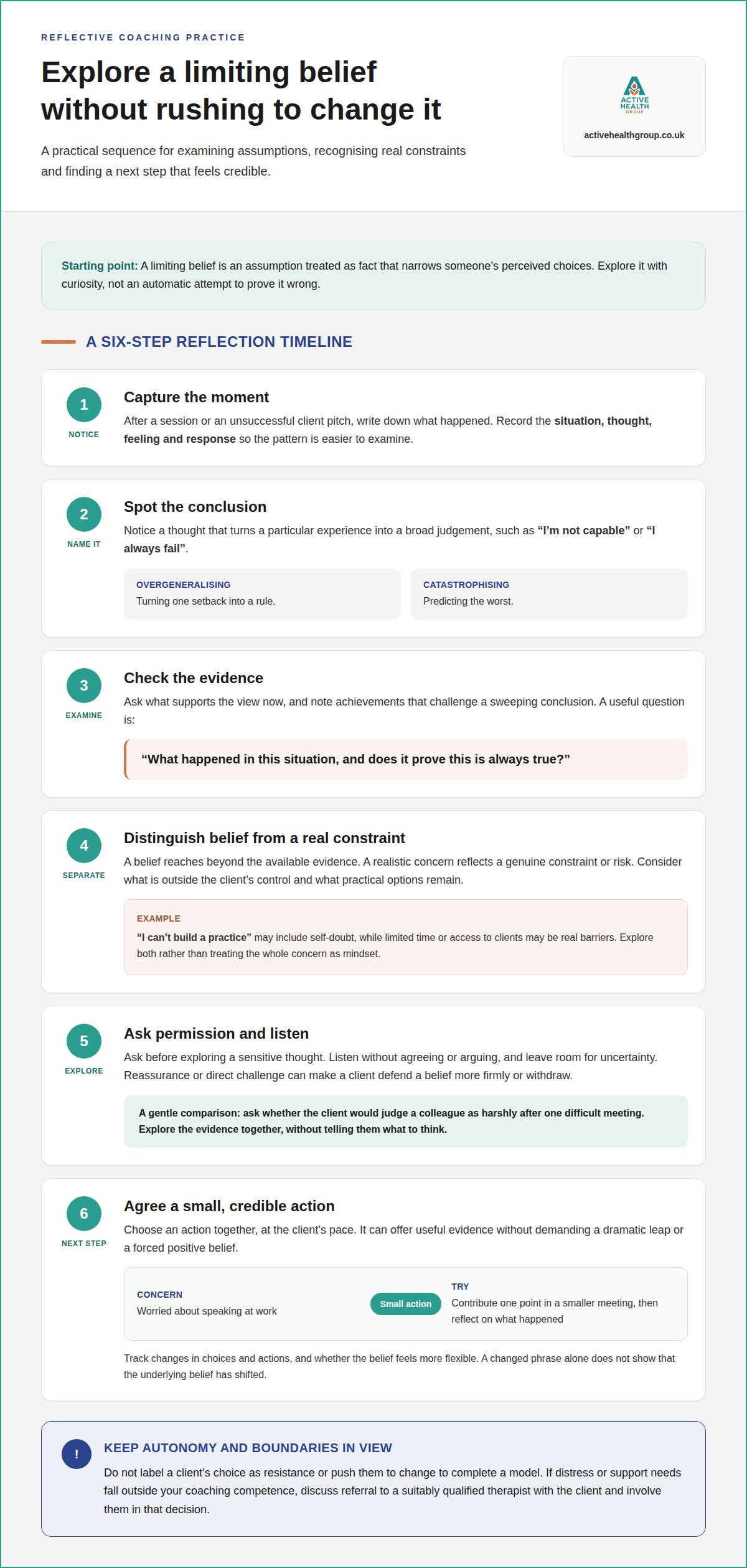
Self-reflection means examining the thoughts and assumptions shaping your response to a situation. It matters because familiar patterns can go unnoticed, even when they influence decisions. After a session or an unsuccessful client pitch, record the situation, thought, feeling and response. Then note achievements that challenge any sweeping conclusion. Ask yourself, “What evidence supports this view?” and “What choices might I make without it?”
Distinguishing Beliefs from Realistic Concerns
A limiting belief reaches beyond the available evidence, while a realistic concern reflects a genuine constraint or risk. Explore what supports the belief now, what lies outside the client’s control, and what practical options remain. For example, “I can’t build a practice” may reflect self-doubt, but limited time or access to clients may be real barriers. Track progress through changes in choices and actions, as well as whether the belief feels more flexible.
Examples and Cognitive Distortions
Limiting beliefs are conclusions about oneself, such as “I’m not capable of changing” or “I always fail”. Cognitive distortions are habitual thinking patterns that can reinforce these conclusions. Overgeneralising turns one setback into a rule; catastrophising predicts the worst. Ask, “What happened in this situation, and does it prove this is always true?” If the client’s distress or support needs fall outside your coaching competence, discuss referral to a suitably qualified therapist, involving the client in that decision.
Why reassurance or direct challenge can backfire
“You’re clearly capable” may be meant as reassurance, but it can overlook the thought behind a client’s hesitation. Arguing that a belief is wrong may lead the client to defend it more firmly or withdraw. At that moment, feeling safe may matter more than moving towards a goal. Ask permission to explore the belief, then listen before offering another perspective.
Gently explore double standards in how clients judge themselves. If a client calls a presentation “a complete failure”, you might ask whether they would judge a colleague as harshly after one difficult meeting. The comparison can reveal assumptions without telling the client what to think. Examine the evidence together, then ask how a more balanced description feels. A changed phrase alone does not show that the underlying belief has shifted.
Reframing works best when the alternative feels credible and opens up more choices. Rather than replacing “I’ll never be ready” with “I can do anything”, explore what preparation would make an application feel manageable. Repeatedly challenging the same belief can feel like pressure, particularly if the client senses you expect a particular answer. Leave room for uncertainty and let the client set the pace.
Comfort zones can be explored through a small, agreed action, not a forced leap. A client worried about speaking at work might choose to contribute one point in a smaller meeting, then reflect on what happened. That experience can provide useful evidence without requiring them to disprove every concern. Developing health coaching skills can support more considered conversations that help clients move forward at their own pace.
Limiting beliefs affecting coaches
Coaches can bring assumptions into their work, including beliefs about their own competence or clients’ capacity to change. These thoughts may shape professional choices and relationships.
Coaches’ Own Limiting Beliefs
A coach’s limiting belief is an assumption about their own ability that restricts their professional actions. Recognising it matters because it can affect how confidently they discuss goals, boundaries and progress. For example, “I need more training before I can approach anyone” may prompt useful learning, or delay practice without a clear reason. Reflect on the evidence, then identify one safe action that would test the assumption.
Ethical Boundaries in Belief Work
Ethical work with beliefs keeps the client’s autonomy and real circumstances at the centre. Ask permission before exploring a sensitive thought, listen without agreeing or arguing, and allow time for reflection. Don’t assume a difficulty is simply a mindset issue: limited resources or other external barriers may be part of the reality.
Consider your own assumptions, too. If a client declines an action, don’t label their choice as resistance or push them to change just to complete a model. Your role is to support their choices, not impose a positive belief. If the conversation moves beyond your competence, discuss appropriate support with the client and respect their decision. This boundary protects the coaching relationship and keeps the work focused.
To strengthen reflective practice, explore professional development resources that support thoughtful, ethical coaching.
Active Health Group
Active Health Group is a not-for-profit organisation offering professional training for people developing their knowledge and practice in health coaching and nutrition. If you want to strengthen your coaching foundations or extend your nutrition expertise, its qualifications provide pathways from health coaching study to more specialised learning.
For example, the Level 5 Certificate in Coaching for Health and Wellbeing is relevant to learners building coaching knowledge, while the Level 6 Diploma in Health Coaching and Clinical Nutrition combines coaching and nutrition study. These programmes can support your development as you work towards applying reflective, ethical coaching practice with clients.
Further training may suit you if you want structured learning to complement your experience, clarify professional boundaries or develop your understanding of behaviour change. Explore Active Health Group’s learning pathways and arrange a Course Clarity Call with a tutor to discuss your professional goals.
Build your next step in coaching practice
Working with limiting beliefs in coaching calls for reflective practice as well as attention to each client’s circumstances. To strengthen your own foundation, consider what knowledge or skills would support your next stage of practice. The Level 3 Certificate in Health Coaching offers a route for developing coaching knowledge before progressing towards more advanced study.
Set a practical learning goal, such as improving how you listen for assumptions or structure reflective conversations. Then consider which training pathway best fits your experience and professional direction. A Course Clarity Call with an Active Health Group tutor can help you identify a clear next step and build your practice with care and sound judgement.
Contact Active Health Group to discuss your development options. Keep learning at a pace that supports thoughtful, ethical work with clients.
Frequently Asked Questions
What are limiting beliefs in coaching?
Limiting beliefs can include conclusions absorbed from family, school or work and later applied more widely. A client who was repeatedly criticised for making mistakes, for example, may avoid learning unfamiliar skills. Exploring where an assumption began can help distinguish an old protective response from what the person wants to believe or practise now.
How can a coach identify limiting beliefs without making assumptions?
Look for a repeated mismatch between the client’s stated aim and their choices in different situations. For example, they may value rest but regularly dismiss opportunities to take breaks. Describe the pattern neutrally, then invite the client to say whether it feels relevant. Their response, including disagreement, helps ensure the interpretation remains theirs.
What techniques help clients reframe or change limiting beliefs?
One option to explore with a client is trying a credible alternative and noticing whether daily experiences support it. For instance, “I can learn at my own pace” may feel more believable than “I never struggle”. They could also ask trusted people for ideas when considering a difficult situation. Revisit the wording over time and let the client decide whether it remains useful.
What are the risks of challenging a client’s beliefs too quickly?
A belief may have helped someone manage uncertainty or avoid a situation they once experienced as unsafe. Taking that explanation away before understanding its function can leave the client without a familiar way to cope. A rushed approach may also centre the coach’s preferred outcome rather than the client’s priorities. Explore what the belief does for them before considering alternatives.



Comments